Playing Keno in New Zealand: Rules and Draws
 Available in US
An overview of how number selections, entry timing and draw results determine Keno matches and prizes in New Zealand.
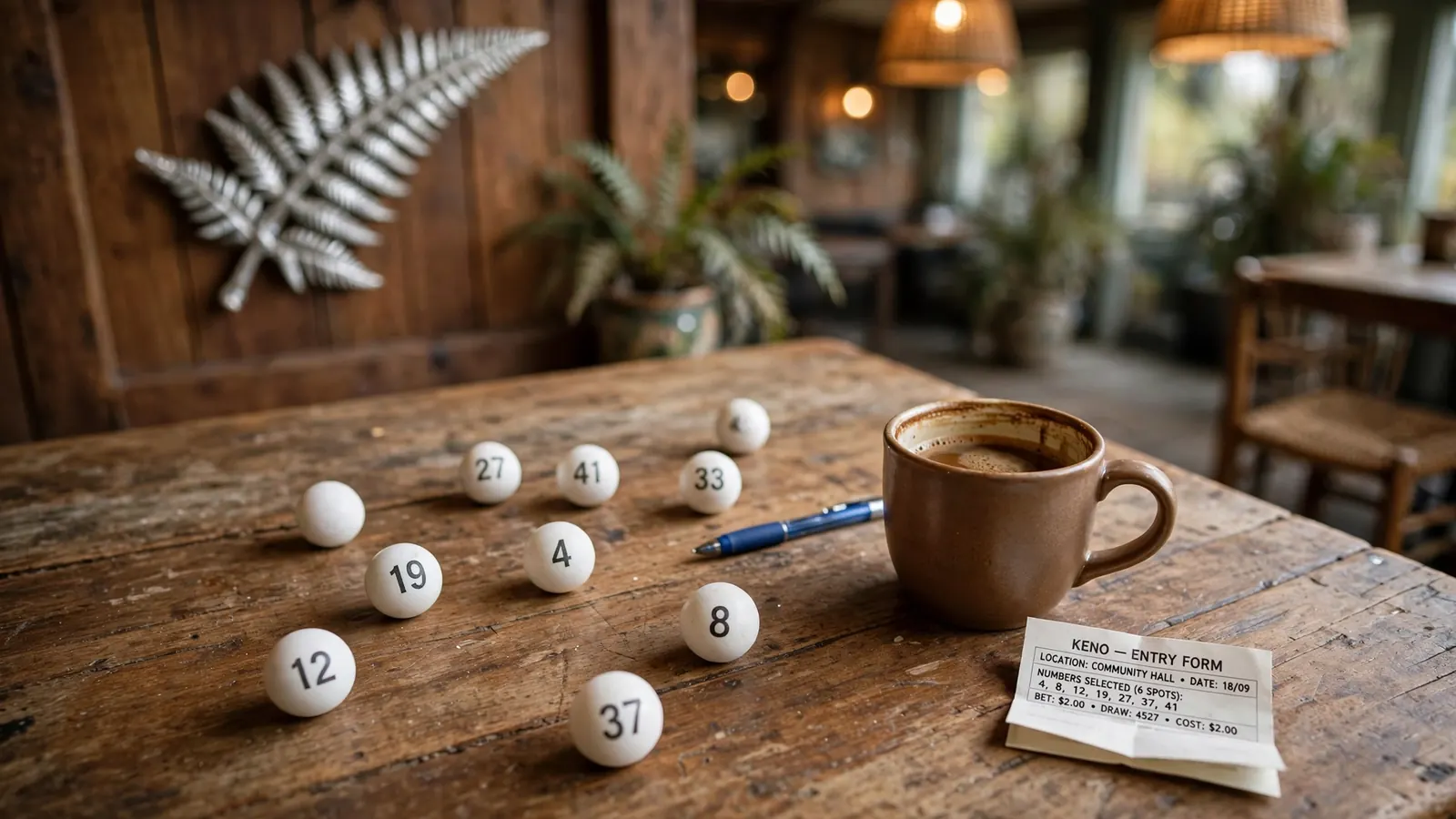
Table of Contents
- The Draw: Numbers, Picks and Entry Timing
- How Hits Turn into Wins
- Keno Rules and Entry Conditions in New Zealand
- Keno in New Zealand: Market and Licensing Context
- Daily Keno: Draw Times and Ways to Enter
- Reading the Keno Prize Table
- Keno Payout Charts: What They Can—and Cannot—Show
- Keno Winners and Unclaimed Prizes
- Why Each Keno Draw Stands on Its Own
- Keno’s Maximum Win: What the Verified Rules Establish
The Draw: Numbers, Picks and Entry Timing
Keno NZ follows a simple sequence: a player marks numbers for an entry, the entry is recorded for a particular draw, and the draw produces a set of numbers. The central mechanics are fixed: twenty numbers are drawn from a pool of eighty, while an entry can contain between one and ten selected numbers.
The pool is the full set from which the draw is made; it is not the number of picks required for an entry. A selection may be small or may include as many as ten numbers. Once the draw takes place, its twenty drawn numbers can be compared with the numbers on the entry. That comparison determines how many selections match, but the act of choosing numbers does not change the draw itself.
From selection to a recorded entry
The first decision is the selection: which eligible numbers to mark and how many to include, within the one-to-ten range. An entry is tied to a draw, so timing matters as much as the marked numbers. It must be submitted before that draw closes. At the scheduled draw time, entry closes; a selection submitted after that point cannot be treated as an entry for the draw that has already begun.
Choosing where to play keno in New Zealand means checking which details matter to you before signing up. This list gives a brief reference point based on the operator information available.
License: Tobique Gaming Commission, licence no. 0000064 Neospin lists a licence from the Tobique Gaming Commission, number 0000064.
License: Malta Gaming Authority, licence no. MGA/B2C/370/2017 Play Grand lists a Malta Gaming Authority licence, number MGA/B2C/370/2017.
License: Tobique Gaming Commission, licence no. 0000091 7Bit Casino lists a licence from the Tobique Gaming Commission, number 0000091.
Payout speed: 1-3 business days Wintino lists a payout speed of 1–3 business days.
Payout speed: 1-3 business days Lamabet lists a payout speed of 1–3 business days.
License: Tobique Gaming Commission, licence no. 0000002 Ricky Casino lists a licence from the Tobique Gaming Commission, number 0000002.
License: Malta Gaming Authority, licence no. MGA/B2C/394/2017 N1 Casino lists a Malta Gaming Authority licence, number MGA/B2C/394/2017.
License: 07017519840 · Payout speed: 1-3 business days Zotabet lists licence number 07017519840 and a payout speed of 1–3 business days.
License: Curaçao Gaming Authority, licence no. OGL/2024/165/0185 BitStarz lists a Curaçao Gaming Authority licence, number OGL/2024/165/0185.
This creates a clear order. Numbers are selected first, the entry is placed for a draw, and the draw then supplies the results. The closing point is not a flexible interval after the draw starts. It is the scheduled draw time itself. For that reason, an entry intended for a particular draw needs to be complete before the cutoff, rather than being left until the result is underway.
Keno is not a game in which the marked numbers are drawn one by one by the player. The player defines a selection from the pool; the draw then produces twenty numbers independently of the selection. The two sets can be compared only after the draw. In a twenty-number Keno game, the number of results is twenty even when an entry contains fewer selections.
The size of an entry and the size of the draw are separate quantities. A selection of one number still faces a draw of twenty numbers from the eighty-number pool. A selection of ten numbers faces the same draw; the larger selection does not cause additional numbers to be drawn. It simply creates more selected numbers to compare with the same result. This distinction keeps the mechanics clear: the entry sets the chosen numbers, while the draw sets the outcome numbers.
Timing is part of the entry
The scheduled close is a boundary, not a suggested target. Before it, an entry can be submitted for the relevant draw. At the scheduled time, that draw’s entry window closes. The next draw is a separate opportunity to place an entry, with its own closing point. A delay therefore matters: an entry arriving after the cutoff cannot be added retroactively to the closed draw.


The basic process can be understood without a strategy or a prediction. Select from the pool, make sure the selection is attached to the intended draw before its scheduled close, and wait for the draw of twenty numbers. The draw does not adjust its count to match the number selected, and the selection does not alter which numbers are drawn. Those are distinct parts of the process.
The term “entry” refers to the recorded selection for a particular draw, not merely a set of numbers written down in advance. A list kept separately has no place in a draw until it is submitted in time. The cutoff gives the selection its timing condition; the draw gives it a result. Both are needed for the sequence to be complete.
For a first-time explanation, the useful mental model is two sets and one cutoff. One set is the player’s chosen numbers, limited to one through ten. The other is the draw’s twenty numbers, taken from the pool of eighty. The cutoff determines whether the chosen set is entered for that draw. Once the scheduled time arrives, the entry window is closed and the draw proceeds with its fixed number of results.
That is the working sequence behind Keno NZ: select, submit before the scheduled close, then compare the selection with the twenty numbers drawn. The mechanics are compact; the timing condition is exact.
Keno Entry Process
Choose between one and ten numbers from the pool of eighty.
Submit the selection as an entry before the scheduled draw time.
Wait for the draw to produce twenty numbers independently of the selection.
Compare the chosen numbers with the twenty drawn numbers to determine the hit count.
How Hits Turn into Wins
A Keno result is measured by comparing the numbers selected for an entry with those drawn. Each selected number that also appears in the draw counts as a hit. The hit count is the starting point for assessing the result; it is not, by itself, a complete description of the payout.
There is no single number of hits that guarantees a win for every entry. The outcome depends on two linked details: how many numbers were selected and how many of those numbers were drawn. A hit count must therefore be read in the context of the selection size. The same count can have a different significance for entries with different numbers of selections, because the payout calculation takes both figures into account.
The prize increases as more of the selected numbers match the draw. That does not mean every additional hit produces the same increase, or that a stated hit count can be translated into one fixed cash amount without considering the entry’s selection size and applicable prize information. The hit result describes the match; the relevant payout terms determine its monetary value.
This distinction matters when assessing how many numbers need to match to win in Keno NZ. The question has no universal answer that applies to every selection. A result is not assessed by counting drawn numbers alone: it is the overlap between the player’s selection and the draw that matters. A selection with some matches may have a different outcome from another entry with the same number of matches if the entries contain different numbers of selected numbers.


For the same reason, asking how many numbers are needed to win on a particular night does not produce a separate rule. The draw date does not alter the relationship between selected numbers, hits and payout. The amount associated with a result cannot be inferred from the hit count alone; it depends on the selection size as well. A cash figure without those details would leave out part of the calculation.
Hit count is not a strategy
A number’s past frequency does not give it a better chance of appearing in the next draw. Lists of “hot” numbers or the most commonly drawn numbers describe earlier results, not a dependable advantage for a future entry. A number that appeared frequently in a recorded period is not thereby more likely to appear again, and a number that appeared less often is not due to return.
Patterns can look persuasive after the fact because a completed draw can be arranged into apparent runs, clusters or repetitions. Those descriptions do not change the probability governing a later result. Choosing numbers based on a pattern may change which numbers appear on an entry, but it does not make the draw more likely to match them. A pattern is a selection preference, not a prediction.
The same limit applies to automated or personal number choices. A repeatable method can make selections consistent, but consistency is not an increase in the probability of a match. The useful distinction is between a method for choosing numbers and evidence that the method improves an outcome. Past draw frequencies provide the former at most; they do not establish the latter.
- Read hit counts in the context of selection size
- Use payout terms to determine monetary value
- View each draw as a random, independent event
- Rely on “hot” numbers or past frequency
- Assume a pattern increases match probability
- Use a repeatable method to improve outcomes
What the result can establish
Once a draw is complete, the hit count gives a precise account of how many selected numbers matched. It can then be considered alongside selection size and the applicable prize information to identify the outcome. Without both sides of that comparison, a hit total cannot answer how much the entry pays.
This is also why “more hits” and “a larger prize” should not be treated as interchangeable descriptions without context. More matched selections increase the prize, but the payout still depends on how many numbers were selected in the first place. A comparison between two results needs both selection sizes and hit counts; comparing hit totals alone may omit a material term.
For a practical reading of a result, the order is straightforward: identify the number of selections, count the matches, then assess that combination under the relevant payout terms. No historical frequency list can replace that comparison. Nor can a chosen sequence, a perceived hot number or a number that has been absent from recent results establish a reliable route to a win. The calculation begins with actual matches, not with a story about why particular numbers ought to appear.
Keno Rules and Entry Conditions in New Zealand
A Keno entry is governed by three practical terms: the selection range available for the game, the amount staked on each selection, and the time at which the entry closes. Those terms determine whether an entry is accepted for a particular draw and how much is committed. They are separate from the later calculation of a result.


Selection limits are not stated consistently
Descriptions of Keno do not agree on the number of figures a player may select. One version gives a range of one to ten numbers for Keno, while another says online Keno allows four to twenty. These ranges cannot be combined into a single rule: they differ in both the minimum and the maximum, and the second specifically refers to online play.
That distinction matters when checking the terms for a particular entry. A range described for Keno generally does not automatically confirm the range available online, and an online range does not resolve the broader statement. The disagreement should remain visible rather than being presented as one settled selection limit.
For playing Keno in New Zealand in 2026, the selection range should therefore be read as a condition attached to the specific entry format, not as a universal figure that applies without qualification. The number of selections affects the structure of the entry, but it does not establish what stake options are available or when the entry must be submitted.
Standard Keno stake options
For standard Keno, the listed cost choices per selection are $1, $2, $3, $4, $5, $10, $20, $50 and $100. The amount applies to each selection, so the chosen stake is not a single flat cost for an entry containing several selections. The calculation is based on the cost per selection and the number of selections included.
This makes the wording of the stake condition important. A displayed amount should be understood as applying to a selection, rather than assumed to cover every selection on the entry. The available choices are discrete: the listed options do not include every amount between the lowest and highest values. A stake outside that set should not be assumed to be available.
Standard Stakes
The available cost choices per selection are $1, $2, $3, $4, $5, $10, $20, $50 and $100.
The stake is the amount committed to the entry; it does not, by itself, describe the possible return. A keno winner in New Zealand is determined under the game’s result and prize terms, not simply by choosing a larger stake. The stake condition and the outcome condition are separate parts of the rules.
Draw schedule and closing time
Keno NZ has four scheduled draws each day: 10 am, 1 pm, 3 pm and 6 pm. An entry closes at the scheduled time of its draw. That makes the closing time a firm boundary for deciding which draw an entry can join, rather than a general indication of when the game is available.
The schedule also means that the relevant time is the listed draw time, not the time at which a result is later reviewed. Once the scheduled draw time has arrived, the entry window for that draw is closed. An entry submitted after that point cannot be treated as timely for the draw that has already reached its closing time.
In practical terms, the entry conditions should be read together: the selection range for the format being used, the stake cost per selection, and the scheduled closing time. These are the terms that govern the entry before a result exists. The conflicting selection descriptions remain a material qualification; the stake menu and daily schedule do not resolve that conflict.
Keno in New Zealand: Market and Licensing Context
Keno NZ sits within New Zealand’s gambling landscape, but the rules for online casino services are a separate matter from the game itself. The central distinction is between oversight of gambling and the decisions made on individual online casino licence applications. Treating those responsibilities as interchangeable would give a misleading picture of who regulates what.

The Department of Internal Affairs is New Zealand’s primary gambling regulator and oversees the online casino licensing framework. The Gambling Commission has the licensing decision-making role: it hears and determines casino licence applications, issues licences and approves changes to licence conditions. In practical terms, the Department oversees the framework, while the Commission handles the formal licensing decisions.
The framework changed with the Online Casino Gambling Act 2026, which came into force on 1 May 2026. It establishes New Zealand’s first domestic licensing regime for online casino gaming. This is distinct from the earlier position under the Gambling Act 2003, which does not allow online casinos to be based in New Zealand. Before the new Act, online casino gambling provided from offshore was not licensed or supervised by a New Zealand regulator. A customer wagering with an offshore website during that period had no domestic government recourse.
The change does not mean that every online casino is already licensed under the new system. The Act provides a transition from 1 May 2026 to 1 December 2026. Providers that were already serving people in New Zealand before 1 May may continue during that window, subject to the Act’s transitional provisions. Providers that have not applied for a licence must cease online casino gambling in New Zealand by 1 December 2026. If an application is declined, the provider must stop those operations and leave the market. The full licensed regime is not expected to be operational until 2027, and unlicensed operation is expected to become an offence around mid-2027.
Licensing Warning
Providers that have not applied for a licence must cease online casino gambling in New Zealand by 1 December 2026.
Those dates matter because “licensed” and “permitted to continue during transition” describe different positions. A provider’s ability to operate during the transition should not be mistaken for a licence issued under the new regime. Nor does the fact that an online casino can be accessed from New Zealand establish that it has domestic approval. The Act sets out a route to licensing; the Commission’s role is to assess applications and determine which providers meet the conditions.
Keno itself should not be treated as proof that a casino operator holds a New Zealand online casino licence. The game name does not establish the legal status of the service offering it. For market context, the relevant questions are which framework applies to the product and, where an online casino licence is at issue, whether the provider is covered by the transition or has obtained a licence through the Commission.
Advertising is also constrained during this period: providers are prohibited from advertising online casino gambling to people in New Zealand during the transition. That restriction is part of the wider regulatory setting, not a statement about how Keno works or a recommendation to use any particular service. The regulatory map is therefore straightforward: the Department of Internal Affairs oversees the gambling framework, while the Gambling Commission determines online casino licensing matters.
Daily Keno: Draw Times and Ways to Enter
Keno NZ has four scheduled draws each day: 10 am, 1 pm, 3 pm and 6 pm. The timetable gives each entry a fixed draw to be associated with; it is not a continuous game in which a result is produced whenever a player submits a selection. The practical question is therefore which draw an entry is intended for and whether it is placed before that draw begins.

A specialist affiliate review describes three ways to enter Keno NZ: through an official lottery retailer, a mobile app or a website, where tickets are legally sold. That account is a description of reported access channels, not a guarantee that every channel is available in every location or at every time. Retail availability depends on the region, and online access should not be read as a statement that the same product is offered across New Zealand.
Choosing an entry channel
A retailer provides an in-person route. App and website entry are digital alternatives, but their availability is tied to the relevant service and the region in which Keno NZ tickets may legally be sold. These are distinct access methods, not different draw schedules: the daily timetable remains the same regardless of how an entry is submitted.
The channel can affect the practical steps involved in submitting an entry, but it does not itself determine the result. A mobile screen is simply an interface for placing an entry; it does not change the draw or make a particular selection more likely to match. Likewise, using a retailer rather than a website does not create a separate set of Keno NZ draw times.
Mobile access is not universal
A specialist affiliate review notes that mobile provision varies: not every casino has an app, and the games available on mobile may differ from those offered elsewhere. That observation concerns casino products generally, so it should not be mistaken for confirmation that any particular provider carries Keno NZ. App availability alone is not evidence that the game is included, and a mobile-friendly website is not necessarily a separate app.
Attention: The presence of a mobile app or a mobile-friendly website does not guarantee that Keno NZ tickets can be legally bought through that channel in your region.
For Keno NZ, the relevant distinction is between an entry route that is actually offered for the product and a device that can display a service. The existence of a phone app does not establish that Keno NZ tickets can be bought through it. The same applies to a website: access to a site does not, by itself, confirm ticket sales in a given region.
The schedule is the firmest planning detail: four daily draws, at 10 am, 1 pm, 3 pm and 6 pm. The available route may be a retailer, app or website, but the reported online options are conditional on legal ticket sales in the region. Mobile access should be checked as a product-specific feature, rather than inferred from the presence of an app.
Reading the Keno Prize Table
A Keno prize table connects two details: how many numbers were selected and how many of those numbers were drawn. The same hit count does not necessarily correspond to the same prize across different selection sizes. A table therefore needs to be read at the intersection of the relevant selection size and hit result, rather than by looking at the hit count alone.
The selection size identifies the set of numbers on the entry. The hit count records how many from that set appear in the draw. Find the entry’s selection size first, then locate the result for its number of hits. The corresponding table cell gives the listed prize for that combination. Reading across the wrong selection row can produce a figure that belongs to a different entry, even when the hit count appears to match.
This makes the table a reference for outcomes, not a forecast. It shows how the prize is assigned after a result is known; it does not indicate which numbers are more likely to be drawn. Nor does a high hit count have a fixed meaning without the selection size beside it. The two variables work together, so neither one alone is enough to identify the applicable prize.
For a New Zealand Keno prize table, the practical check is to match the entry’s selection size to the table’s corresponding category and then match the result to its hit count. If the table presents more than one prize category for that selection size, the exact hit result matters. A prize should not be inferred from a neighbouring cell or from a different selection category. The displayed combination, not a general impression of how many numbers matched, determines the listed outcome.
A table can also be misread when its headings are treated as interchangeable. “Numbers selected” describes the entry; “hits” describes the overlap between that entry and the draw. These are related but distinct measures. The selected number count does not itself establish a prize, and the hit count does not identify the applicable table entry unless the selection size is known as well.
The prize rises as more of the selected numbers match the drawn numbers. That relationship explains why the table separates outcomes by hits, while its selection categories account for the size of the original entry. It does not support comparing two results by hit count alone: the selection sizes must also be the same before the table positions are directly comparable.
How to read the prize table
First, identify the entry’s selection category. Second, locate the recorded hit count within that category. The prize is found at the intersection of these two variables; reading across the wrong selection row will result in an incorrect payout figure.
When checking Keno prizes in New Zealand today, the useful reading is therefore narrow and mechanical: identify the selection category, identify the recorded hits, and use the cell where those details meet. The table’s stated amount applies to that combination. A figure detached from its row or category is not a reliable reading of the prize table.
Keno Payout Charts: What They Can—and Cannot—Show
A Keno payout chart is a lookup table, not a forecast. Its core inputs are the number of selections on an entry and the number of those selections that match the draw. The relevant cell shows the payout assigned to that combination under the chart’s terms. A chart therefore needs to be read by both dimensions; a hit count on its own does not establish a payout.
The selection-size row or column matters because the same number of hits can produce different outcomes for entries with different numbers of selections. Reading across a single hit count while ignoring selection size can therefore give the wrong result. The chart describes the payout rules for combinations of selections and hits; it does not say how likely any combination is to occur.
A chart presented as current can identify the payout terms being displayed for that point in time. The word “today” does not turn it into a record of today’s winning numbers, nor does it imply that previous results have predictive value. Past frequency does not change the probability of a number appearing in a later Keno draw. Each draw is random and independent, so a number appearing often in earlier results is not thereby due to appear again—or less likely to do so.

The distinction is between a payout schedule and a probability claim. The chart answers, “What payout is assigned if this selection size records this hit count?” It does not answer, “Which numbers should be selected?” or “What will the next draw produce?” Historical results may describe what has already happened, but they cannot alter the next draw’s probabilities.
For a usable comparison, the chart’s headings and the conditions attached to it need to be read together. The selection size must match the entry being assessed, and the hit count must match the result. If either is mismatched, the displayed payout is not the applicable one. Where the chart does not clearly identify those terms, a precise payout cannot be inferred from it.
This keeps the chart in its proper role: a map from a result to a payout, not a strategy and not evidence that a particular set of numbers has an edge.

Keno Winners and Unclaimed Prizes
A Keno win does not settle the matter of the prize: it must also be claimed within the applicable period. For New Zealand Keno, a specialist affiliate review reports that an unclaimed prize is forfeited after 12 months, with the money returned to the Prize Reserve Fund. That is a specific account from a secondary source, not a rule that should be treated as confirmed for every prize or current claim situation.
The distinction matters because “winner” can describe two different points in the process. A result may show that a prize was awarded, while the prize itself remains unclaimed. If the reported forfeiture condition applies, leaving it unclaimed beyond the stated period means the entitlement ends and the funds return to the reserve. The review’s account does not establish how the deadline is calculated, what documents are needed, or which channel handles a claim. Those details should not be inferred from the deadline alone.
Unclaimed Prizes
According to a specialist affiliate review, unclaimed prizes are forfeited after 12 months and returned to the Prize Reserve Fund.
For someone checking whether a Keno NZ prize remains payable, the practical issue is therefore the status of that particular award and the applicable claim terms. A report of a winning result is not, by itself, confirmation that a prize has been collected. Equally, the stated 12-month period should not be treated as a personalised deadline without confirming when it begins and whether it applies to the prize in question.
This is a narrow but material point for Keno winners in New Zealand: the reported outcome for an unclaimed prize is forfeiture, not indefinite retention. The associated return to the Prize Reserve Fund describes where the money goes after forfeiture; it does not mean the prize remains available to the original winner. Because the deadline is reported by a specialist affiliate review, rather than established here as a current universal condition, the claim terms for the relevant ticket or award are the controlling detail. A prize should not be assumed to remain claimable simply because the winning result can still be found.
Why Each Keno Draw Stands on Its Own
Keno NZ is a random game, and each draw is independent of the one before it. In a 20-number game, exactly 20 numbers are drawn. Once that draw is complete, its results do not alter the probabilities in the next draw.
A number appearing often in past results is no more likely to appear next time because of that frequency. The reverse is also true: a number absent for several draws has no probability debt to repay. Each draw is a separate event, not a running correction of earlier outcomes.
This distinction matters when reviewing Keno statistics. A record of past results can describe what happened; it cannot establish what will happen next. Counting appearances may reveal historical frequency, but it does not turn that record into a forecast. A sequence that looks uneven is compatible with random outcomes and does not, by itself, show that the process has changed.
The same reasoning applies to a number that has just appeared. Its recent appearance does not make it less likely in the next draw. Treating recent results as a signal—whether to repeat a number or avoid it—adds no predictive force to the selection.
So, how does Keno work in New Zealand at this level? Each draw produces its own random result, and earlier draws do not change the chance of a number being included later. Past frequency is a description of history, not an advantage for the next entry.

Keno’s Maximum Win: What the Verified Rules Establish
There is no single maximum win that can be calculated from the number of hits alone. A Keno payout depends on both how many numbers were selected and how many of those selections match the draw. The prize rises as more selected numbers are matched, but that relationship does not establish a maximum dollar figure.
For a specific entry, the relevant amount is the prize assigned to its selection size and hit count in the applicable payout table. A result with the same number of hits can therefore have a different payout when the number of selections differs. The stake also matters when interpreting the amount payable, so a headline figure detached from the entry conditions is not a useful comparison.
The term “maximum win” needs a defined basis: the selection, stake and payout schedule being considered. Without those details, it can refer to different outcomes rather than one fixed ceiling. The mechanics establish how the result is determined; they do not, by themselves, supply a maximum amount in dollars.
That distinction matters when assessing a claim about the largest possible Keno NZ prize. A stated amount is meaningful only alongside the rules and payout schedule that produce it. Hit counts explain the result category, while the applicable table assigns its monetary value. No amount should be inferred from the fact that a prize increases with additional matched selections.
How do you play Keno in New Zealand?
Choose between one and ten numbers, then submit your entry before the draw closes. The draw selects 20 numbers from a pool of 80, and your result depends on how many of your choices match.
What time is the Keno draw held?
New Zealand Keno draws take place four times daily: at 10 am, 1 pm, 3 pm and 6 pm. Entries close at the scheduled draw time.
Do these numbers improve my odds?
No particular numbers improve your odds. Each draw is independent, so past number frequency does not affect the chance of a number appearing next.
Does an app make Keno safer or improve the odds?
An app does not improve your odds: each draw remains an independent random event. Keno can also be played through an official retailer or website where tickets are legally sold.
Written by the editors at Casino Slots Tips NZ.