Online Blackjack in New Zealand: Rules and Licensing
 Available in US
Licensing status, payout terms, table rules and live-dealer formats each shape what an online blackjack game involves.

Table of Contents
- New Zealand’s Online Casino Licensing Framework in 2026
- What Blackjack at an Online Casino Involves
- Blackjack Rules and Payouts: The Terms That Change the Calculation
- Real-Money Blackjack: Payout Terms Before the First Bet
- Free Online Blackjack as a Practice Format
- Online Blackjack Sites, Variants, and Table Rules
- Card Counting Online: What Mental Calculation Does—and Doesn’t—Establish
- Playing Online: The Decisions at the Table
- Strategy Starts with the Table Rules, Not a Betting System
- Live-Dealer Blackjack: Real Cards, Different Trade-Offs
New Zealand’s Online Casino Licensing Framework in 2026
New Zealand’s online casino rules are changing during 2026. The Online Casino Gambling Act 2026, which came into force on 1 May, created the country’s first domestic licensing framework for online casino gambling. The shift is significant: before the Act, online casino services based offshore were not licensed or supervised by a New Zealand regulator. A person using such a site during that period had no domestic government recourse if a dispute arose.
The Department of Internal Affairs (DIA) is New Zealand’s primary gambling regulator and oversees the online casino licensing framework. The Gambling Commission has a distinct role within it: it hears and determines casino licensing applications, issues online casino licences and approves changes to licence conditions. In practical terms, oversight of the framework and decisions on individual licensing matters are assigned to separate bodies.
That division matters when assessing claims about an online blackjack casino. The existence of a licensing framework does not, on its own, establish that a particular site holds a licence or that a specific game is fair. Licensing status is a regulatory question; game conduct and the terms attached to a particular service are separate matters. In 2026, the transition also means that the new regime is not yet fully operational.
Choosing an online blackjack site in New Zealand means weighing what is verifiably known about each operator. This list offers a concise reference point based on the available details.
License: Tobique Gaming Commission, licence no. 0000064 Neospin lists a licence from the Tobique Gaming Commission, licence no. 0000064.
License: Malta Gaming Authority, licence no. MGA/B2C/370/2017 Play Grand lists a Malta Gaming Authority licence, no. MGA/B2C/370/2017.
License: Tobique Gaming Commission, licence no. 0000091 7Bit Casino lists a licence from the Tobique Gaming Commission, licence no. 0000091.
Payout speed: 1-3 business days Wintino’s stated payout speed is 1–3 business days.
Payout speed: 1-3 business days Lamabet’s stated payout speed is 1–3 business days.
License: Tobique Gaming Commission, licence no. 0000002 Ricky Casino lists a licence from the Tobique Gaming Commission, licence no. 0000002.
License: Malta Gaming Authority, licence no. MGA/B2C/394/2017 N1 Casino lists a Malta Gaming Authority licence, no. MGA/B2C/394/2017.
License: 07017519840 · Payout speed: 1-3 business days Zotabet lists licence number 07017519840 and a stated payout speed of 1–3 business days.
License: Curaçao Gaming Authority, licence no. OGL/2024/165/0185 BitStarz lists a Curaçao Gaming Authority licence, no. OGL/2024/165/0185.
A transition before full licensing
The Act sets a transitional period from 1 May to 1 December 2026. Online casinos that were already providing services to people in New Zealand before 1 May may continue operating during that window, subject to the Act’s transitional provisions. This continuation is not the same as having completed the full domestic licensing process. The full licensed regime is not expected to be operational until 2027.
The transition is limited to providers already operating in the market before the Act took effect. It does not mean that any new offshore casino can treat the period as an open invitation to begin serving New Zealand customers. Nor should the existence of a website, or its availability to a New Zealand visitor, be mistaken for evidence of a New Zealand licence.
The Gambling Act 2003 bars online casinos from being based in New Zealand. The 2026 Act establishes a domestic licensing regime for online casino gaming, while retaining a distinction between providers operating from within the country and services offered from offshore. New Zealand residents have been able to access offshore casino sites, and the legal framework does not impose a fine or criminal prosecution on a player simply for wagering with an offshore casino that lacks a local licence. That is different from saying the player has domestic regulatory protection: during the pre-Act period, offshore online casino services were outside New Zealand licensing and supervision, and customers had no domestic government recourse.

What the regulators do
The DIA’s oversight role places it at the centre of gambling regulation, including the framework governing online casino licences. The Gambling Commission handles licensing decisions: it considers applications, determines them, issues licences and approves changes to licence conditions. These responsibilities should not be collapsed into a vague claim that “the government regulates casinos.” The relevant question is which authority is responsible for the particular function.
The framework also sets consequences and obligations for providers. Unlicensed operation is expected to become an offence from around mid-2027. Operators without a licence may face enforcement action and fines of up to NZ$5 million. Providers that have not applied for a licence must cease online casino gambling in New Zealand by 1 December 2026; if an application is declined, the provider must stop those operations and leave the market.
The transition imposes a separate restriction on promotion. Online casino gambling services may not be advertised to people in New Zealand during the transitional period. Later, advertising by licensed operators is permitted only under tight rules, and sponsorships are prohibited. Licensed operators must also apply stricter age and identity verification systems. These are provider obligations, not a guarantee that every site encountered online is licensed or meets the new requirements.
Unlicensed Operation
Unlicensed operation is expected to become an offence around mid-2027, with operators potentially facing enforcement action and fines of up to NZ$5 million.
For a person comparing online blackjack sites, the regulatory picture in 2026 is therefore time-sensitive. A provider’s prior operation may permit it to continue through the transition, but that is not equivalent to a final licence under the complete regime. Conversely, the absence of a New Zealand licence during the transition does not by itself make a player liable to prosecution. The distinction is between a provider’s status and a customer’s legal exposure.
Licensing can answer questions about regulatory authority and permission to operate under New Zealand’s framework. It cannot, by itself, settle whether an individual blackjack game is rigged, whether its terms are favourable, or whether a particular claim about a site is accurate. Those questions require evidence specific to the operator and game. The framework provides a route for domestic oversight; its practical reach is still being established during 2026, before the full licensing regime is expected to be operational in 2027.
What Blackjack at an Online Casino Involves
Blackjack is a contest against the dealer, not a competition among the people seated at the same table. The central aim is to finish with a hand closer to 21 than the dealer’s without going over 21. That gives each decision a clear reference point: the player’s position is judged against the dealer’s, while the value of the hand must stay within the limit.
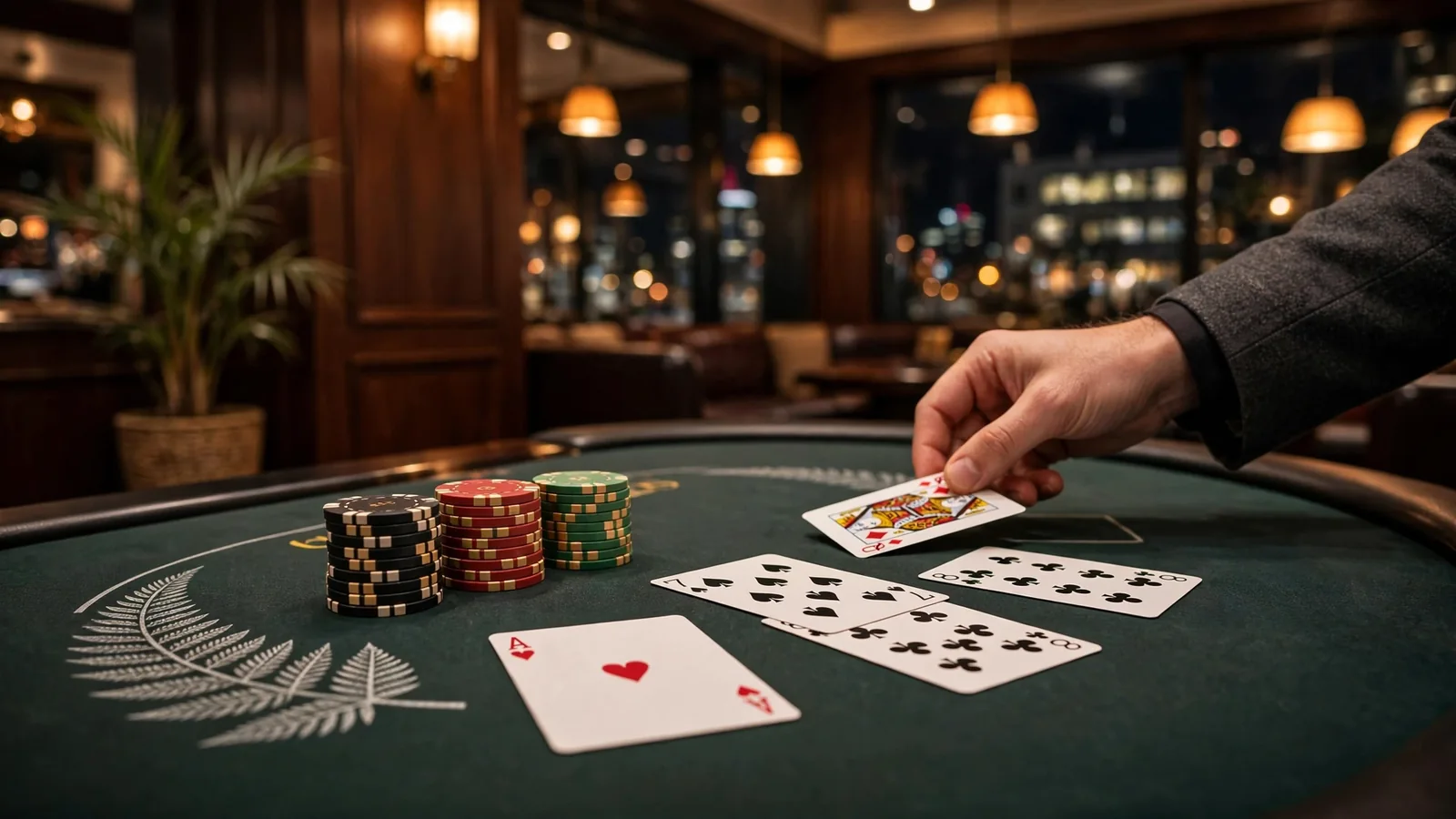
The basic structure is straightforward, but it is not simply a matter of trying to reach 21. A hand can be closer to the target and still lose if the dealer finishes closer; a hand can also lose by exceeding 21, regardless of what the dealer holds. The result therefore depends on both the final comparison and whether either side has gone beyond the limit.
At an online blackjack table, a player chooses how to proceed with the hand from the actions the game offers. The familiar options are to hit, stand, double down, or split. Their availability and exact conditions belong to the table’s rules, so the action names alone do not describe every detail of a particular game. The broad function, however, is to let the player continue, stop, or take a different route with the hand.
Hitting means asking for another card. It can move a hand nearer to 21, but it can also take the total past the limit. Standing means taking no further card and leaving the current hand as it is. These choices frame the main tension of blackjack: continuing may improve the hand, while stopping preserves its present position. Neither action guarantees a better result, because the dealer’s hand still has to be resolved against it.
Doubling down and splitting are additional options. A double down changes how the hand is played, while a split creates separate hands from a pair where the table permits it. These are not merely different labels for hitting or standing: each changes the shape of the decision. Whether either option is available, and what conditions apply, depends on the game being played. That is why the same starting situation need not lead to the same available choices at every table.
Asking for another card to move the hand nearer to 21, with the risk of exceeding the limit.
Taking no further cards and leaving the current hand as it is to be resolved against the dealer.
Changing how the hand is played by increasing the stake in exchange for exactly one more card.
Creating separate hands from a pair where the table rules permit it.
The online setting does not alter the basic objective. Casino blackjack online still centres on the dealer, the player’s hand and the limit of 21. The screen presents the current hand and the actions available at that point; the player’s task is to choose among them under the table’s rules. The game is not won by making the most dramatic move, but by ending in a position that compares favourably with the dealer’s without exceeding the target.
For someone approaching online blackjack in New Zealand, the useful starting point is this structure rather than a promise of winning online blackjack. There is an opponent, a target and a set of possible actions; none removes the uncertainty of the final comparison. A sound understanding of the objective makes the later details easier to interpret, but it does not make every hand predictable. The table’s rules shape what can be done, and the hand’s result remains tied to how both sides finish.
Blackjack Rules and Payouts: The Terms That Change the Calculation
Blackjack’s card values are fixed, but the table’s rules are not. Number cards count at face value, face cards count as 10, and an ace can count as either 1 or 11. That flexibility makes the ace valuable in a hand: its value can change without forcing the total over 21. The same hand can therefore be assessed differently depending on whether the ace is counted high or low.
A natural blackjack is an opening hand made from an ace and a card worth 10. Its payout is a separate term from the value of the cards. A specialist review reports that some tables pay a natural at 3:2, while others pay 6:5. Those ratios are not interchangeable: the return attached to the same result changes with the table. The payout should be read as a stated rule, not inferred from the game’s name or appearance.
That distinction matters when comparing an online blackjack game with another version. A natural payout describes what happens after a particular hand; it does not, by itself, describe the full cost or advantage of a game. Other rules affect how hands develop and how often particular outcomes arise. A table with a more attractive natural payout may still have different conditions elsewhere, so one term cannot stand in for the complete rule set.
A specialist review also notes that games can differ in deck count, in whether the dealer hits or stands on soft 17, in surrender availability, and in blackjack payouts. These are not cosmetic details. Deck count changes the card pool; the soft-17 rule determines what the dealer does with a hand containing an ace counted as 11 and a total of 17. Surrender, where offered, changes the result of a hand by allowing it to be ended under the table’s stated conditions. The precise effect depends on the rules attached to that game.
Table Variations
Games can differ in deck count, whether the dealer hits or stands on soft 17, surrender availability, and natural blackjack payouts.
The word “soft” is useful because it identifies a hand in which an ace can still be counted as 1 if counting it as 11 would take the total beyond 21. A dealer’s soft-17 rule is therefore not the same as a general instruction to hit or stand on every total of 17. The distinction belongs in the table rules, where it can be checked before play rather than guessed from the display.
Payout wording also deserves a close read. A natural blackjack and an ordinary winning hand need not receive the same return, and the table’s listed terms govern the result. A payout written as a ratio expresses the return relative to the stake; a different ratio means a different amount returned for the same qualifying hand. That is a direct change to the calculation, not a matter of presentation.
For comparison, the useful record is compact: card values, natural-blackjack payout, deck count, dealer treatment of soft 17, and whether surrender is allowed. The rules should be read together. Otherwise, a single appealing term can conceal the conditions that determine how the rest of the game is settled.
Real-Money Blackjack: Payout Terms Before the First Bet
A cash stake changes the meaning of every blackjack term: the outcome is no longer just a change in a practice balance. The amount wagered, the return attached to a winning hand and any conditions on promotional funds all affect the final calculation. A displayed win is not necessarily the same as money available to withdraw.

Natural-blackjack payouts illustrate why the table’s terms matter. A specialist review reports tables offering a 3:2 payout, while some offer 6:5. These are reported options, not a guarantee about every online casino blackjack table. The ratio determines the profit on a qualifying hand relative to the original stake; the original stake is accounted for separately. A lower ratio means a smaller profit for the same wager, so the payout line deserves attention before play begins.
That difference is easy to overlook when a game presents an attractive interface or a prominent balance. The relevant comparison is between the stake and the amount credited for the same result. If the payout is unclear, the apparent value of a winning hand cannot be assessed accurately. A cash-game label alone does not establish what the table pays.
Promotional funds add another layer. Bonus conditions may state how funds must be used before a withdrawal is available, and blackjack may contribute differently from other games toward wagering requirements. Maximum bet rules can also apply while those requirements are being met. The amount shown as a bonus is therefore not necessarily equivalent to unrestricted cash. The practical value depends on the conditions attached to it, not on the headline figure.
Those conditions should be read alongside the table’s own payout terms. A favourable natural-blackjack payout does not cancel a restrictive bonus condition, and a bonus does not improve the underlying table payout. They are separate parts of the calculation. Fine print and bonus conditions should be checked on trustworthy sites and casinos before real-money play; otherwise, a balance can be mistaken for a sum that is already available.
Before Real-Money Play
- Check the natural-blackjack payout ratio (e.g., 3:2 vs 6:5).
- Review promotional funds’ wagering requirements and maximum bet rules.
- Set a fixed spending budget.
- Verify the table’s specific payout terms on a trustworthy site.
Real-money blackjack also needs a fixed spending limit. A budget sets the amount at risk before play starts; it does not predict the result or guarantee that the amount will last for any particular period. Once that limit is reached, continuing to recover losses changes the original spending decision rather than repairing it. Chasing losses is not a reliable way to restore a balance.
Insurance is another offered wager, but it should not be treated as a routine addition for most players. It is separate from the main hand and changes the amount at risk. Adding it without accounting for its separate terms makes the total stake less clear, not more favourable.
The same care applies when comparing cash tables across online casinos. A return advertised for one game should not be assumed to apply to another, and a displayed promotional balance should not be treated as cash without checking its conditions. The useful comparison is specific: the table payout, the stake, and any restrictions governing funds. If one of those pieces is missing, the potential return cannot be calculated from the headline alone.
Free play has a different purpose because no cash stake is involved; it cannot establish that a player will win real money. For cash play, the decision rests on terms that can be read before the first wager: what a qualifying hand pays, what restrictions govern promotional funds, and what amount is within the set budget.

Free Online Blackjack as a Practice Format
Free online blackjack removes the cash stake from the hand. It can provide a way to become familiar with a game’s interface and pace without risking money, but it is not the same financial exercise as playing for real stakes. A practice balance has no cash value, and a result in free mode does not establish what a later real-money session will return.
Many free games use random number generator (RNG) software. The software shuffles the cards, and hands can move more quickly than at a live-dealer table because there is no streamed physical deal to wait for. That speed makes it possible to see more hands in a session; it does not make each hand more predictable or improve the value of a decision. Faster play can also make it easier to lose track of time, even when no money is at stake.
Free play is most useful for learning the layout: where the current hand appears, how the game displays its result, and how the controls respond. It can also help identify whether the interface is clear enough to follow. Those are practical observations, not evidence that a player has acquired a reliable method for producing a profit. Practice can reduce uncertainty about the software’s operation; it cannot remove the uncertainty inherent in the game.
Questions about whether an online blackjack game is fair or rigged cannot be settled simply by trying its free mode. A software shuffle describes how cards are dealt, not whether the game’s operation has been independently assessed or whether its published terms are complete. The free result also does not prove how a separate real-money game behaves. The relevant information is the specific game’s rules and disclosed return information, where available, rather than a short run of hands that happened to go well or badly.
Attention: A winning practice session in free mode does not prove that a real-money session is likely to match it or that a game is fair.
The same limit applies to online blackjack return-to-player (RTP) figures. An RTP is a statistical measure of expected return over extended play under stated conditions; it is not a forecast of the result of a practice session or a promise about an individual outcome. A displayed figure should be read alongside the rules for the particular game. Free hands cannot validate a return figure, and a winning practice session does not show that a real-money session is likely to match it.
Online blackjack tips are also easy to misread when tested against play-money results. A sequence of favourable outcomes can make a choice appear proven, while an unfavourable sequence can make a sound choice look mistaken. Free mode can help with familiarity, but a small personal sample is not a dependable test of a strategy or of fairness. Nor does practice establish that a betting system can guarantee a win.
The boundary between practice and cash play matters. Free blackjack is suitable for play as entertainment without a financial stake; it should not be treated as preparation that makes losses less likely. Before real-money play, the amount at risk should fit a set budget, and losses should not be chased. Where wagering requirements apply to a promotion, blackjack may count differently from other games, and maximum-bet rules can apply during wagering. Those conditions belong to the cash offer, not to the free practice balance.
The useful output of free play is narrow: familiarity with the software and a clearer sense of its pace. It is not a substitute for checking the terms of a real-money game, and it does not convert a random outcome into a dependable forecast.
Online Blackjack Sites, Variants, and Table Rules
Tables offered through online blackjack sites are not necessarily the same game with a different screen. A variant can change the rules governing a hand, and that can change both the decisions that make sense and the house edge. The table’s name is therefore a poor substitute for its rules: the conditions attached to the game matter more than its label.
A useful comparison starts with the rule panel for each table. It may specify how many decks are used, how the dealer treats a soft 17, whether surrender is available, and what a natural blackjack pays. These are not cosmetic details. A player’s decision is made within the conditions of that particular game, so a strategy that fits one table may not transfer unchanged to another. The same stated action can have a different calculation behind it when the surrounding rules change.
This is why a blackjack table should be assessed as a complete set of terms rather than by one attractive feature. A more favourable condition in one area does not establish that the game as a whole has a lower house edge. Other rules may offset it. The direction and size of the difference depend on the combination of conditions, not on a single rule read in isolation.
Comparing Table Rules
Useful comparisons should focus on the rule panel, including deck count, dealer treatment of soft 17, surrender availability, and natural blackjack payouts, as these combination of conditions determine the house edge.
A blackjack simulator can help make table variations easier to understand, provided its settings match the game being examined. If the simulator uses different rules, its output describes that version, not the table on an online casino site. A simulation is a way to examine decisions under stated conditions; it is not evidence that an outcome is assured or that a strategy carries over to every variant. The settings are the calculation’s inputs. If they are wrong, the result is wrong with admirable consistency.
Side bets require separate attention. Their presence does not tell anything by itself about the main blackjack game’s rules or house edge. Each side bet has its own terms, so it should not be treated as part of the main hand’s calculation unless those terms are being assessed separately. A table’s main-game conditions and any additional wagers are different pieces of information.
Across online blackjack tables, the practical comparison is therefore between rule sets, not site names alone. The same site can offer games with different conditions, while similarly named variants need not have identical rules. Reading the table information before choosing a game keeps the comparison tied to the actual version being played, rather than to assumptions carried over from another table.
Card Counting Online: What Mental Calculation Does—and Doesn’t—Establish
In New Zealand, card counting carried out through mental calculation is not illegal. That is a narrow statement about the method and its legal status. It does not establish that counting is effective at an online blackjack table, nor does it say anything about whether a particular game’s design gives a count practical value.

The distinction matters because legality and usefulness answer different questions. A player can keep a mental tally without that act being unlawful, while the game’s mechanics may still make the tally irrelevant to the next decision. Treating the legal position as proof of an advantage would turn one fact into a different claim.
Online RNG blackjack uses software shuffles and allows faster play than live-dealer games. The software-based format changes the conditions under which a mental count might be considered: the cards are not being dealt from a physical shoe visible at a table. But the existence of software shuffling alone does not establish how a particular game handles cards between hands, or whether any counting approach can predict what comes next. Those conclusions require information about the specific game, not an assumption based on the word “online.”
This is why “card counting online blackjack” is not one settled proposition. It can refer to the legality of mental arithmetic, the mechanics of an RNG game, or the practical question of whether a count informs play. Only the first has a clear answer here: mental calculation for card counting is not illegal under New Zealand law. The other questions cannot be answered merely by repeating that legal point.
The faster pace of RNG play is also separate from accuracy. More hands can be dealt in less time than at a live-dealer table, but pace by itself does not make a count more informative. It can simply mean that decisions arrive sooner. Speed is a feature of the format, not evidence of an edge.
Legal Status
In New Zealand, card counting carried out through mental calculation is not illegal, though this does not guarantee the method’s effectiveness in online games.
Likewise, a statement that counting is lawful should not be read as a recommendation to use it, or as confirmation that it works across online blackjack games. A method’s potential depends on the game conditions; the fact that a player can perform mental arithmetic does not change those conditions. The practical value of a count cannot be inferred from its legality.
For New Zealand players, the precise conclusion is modest: mental card counting is not prohibited by law, but that fact does not prove that online blackjack can be beaten through counting. RNG software shuffles and faster rounds describe the format; they do not, on their own, supply a basis for claiming that counting predicts the cards.
Playing Online: The Decisions at the Table
Playing blackjack online is a sequence of decisions made after the cards are dealt. The available controls correspond to familiar table actions, but the options shown depend on the rules of that game. The online blackjack dealer remains the opponent; other players, if present, do not make decisions on another player’s hand.
Hit requests another card. It is the choice to continue the hand rather than keep its current total. A hit can improve the hand, but it can also take it beyond the limit, so each additional card changes the position rather than simply adding a chance to improve.
Stand ends the player’s turn with the hand as it is. No further card is requested. The choice leaves the result to the dealer’s turn and the comparison that follows. In practical terms, hit and stand are the basic alternatives: accept the current total or ask for another card.
Double down is a more committed action. It increases the amount at stake while continuing the hand with a further card, after which the player’s decisions are over. Because the wager changes along with the hand, the option is not just another way to draw. The table’s rules determine when it is available.
Split applies when the dealt cards qualify as a pair under the table rules. Rather than play them together, the player separates them into hands and plays each hand in turn. This creates more than one outcome from the original deal, and can also change the total amount exposed. The interface should make clear when splitting is permitted and what action is required for each resulting hand.
Surrender, where offered, gives up the hand under the table’s stated terms instead of continuing to play it. It is not available at every table, so its presence should not be assumed from one game to another. The timing and conditions belong to that table’s rules.
For anyone learning blackjack online, the useful distinction is between an action and its consequence: a hit changes the cards, a stand closes the player’s turn, while doubling and splitting change how the hand or stake is arranged. Before confirming a choice, the displayed controls and rules matter; a button is not a universal promise that the same option is available in every game.
- Match decisions to the actual table rules.
- Use a set budget for stakes.
- Check bonus conditions and fine print.
- Use a strategy detached from specific table rules.
- Chase losses once a budget is reached.
- Rely on betting systems to guarantee profit.
Strategy Starts with the Table Rules, Not a Betting System
A sound blackjack strategy begins with the conditions of the table. Variants do not share identical rules, and those differences can change both the decisions available and the house edge. A strategy detached from the rules is therefore not a calculation; it is a guess with a familiar name.
Before choosing a line of play, establish which version is being dealt and read its rules. The number of decks, how the dealer handles a soft 17, surrender availability and the payout for a natural blackjack can all differ between games. Those terms affect the value of decisions, so a strategy suited to one table may not transfer intact to another. Advanced online blackjack strategy is less about adding complexity than matching decisions to the actual conditions.
Betting systems do not alter the underlying rules or guarantee a profit. Increasing or changing stakes after a loss can change the size of the exposure, but it does not make a losing sequence recoverable by design. A budget sets the amount at risk; once it is reached, continuing to chase losses turns a defined cost into an open one.
Insurance is a separate bet, not a repair to an unfavourable table. Most players are better off avoiding it. The central calculation remains the relationship between the table’s rules and the choices those rules permit, not the appeal of an extra wager.
Real-money terms also sit outside the strategy chart but affect the final account. Blackjack may count differently toward wagering requirements, and maximum-bet rules can apply while those requirements are active. Fine print and bonus conditions should be checked on trustworthy sites and casinos before play. An instant payout label concerns withdrawal terms, not whether a blackjack decision is sound.
Online blackjack strategy is consequently conditional: identify the rules, use decisions suited to that version, and keep staking separate from claims about skill. No betting pattern can turn a house edge into a guaranteed return.
Live-Dealer Blackjack: Real Cards, Different Trade-Offs
Live-dealer blackjack uses actual cards rather than a software shuffle. The game is streamed, bringing the visible action closer to a casino table than an RNG game does. That difference changes the pace, not the basic comparison of terms: a live table may take longer to move through play, while an RNG table can deal hands faster because its shuffle is handled by software.
The delay is a practical cost. A stream can pause or lag between the action at the table and its appearance on screen. That does not alter the cards already dealt, but it can make a hand feel less continuous. Faster play is not automatically better; it simply means decisions and outcomes arrive sooner.
Bet conditions are another trade-off. Live tables may require higher bets than other online blackjack formats. A table’s pace and minimum stake therefore matter together: slower play can mean fewer hands in a period, while a higher entry point can make each hand more consequential to the balance. The format is not a lower-cost version merely because it is online.
For online live blackjack, the useful distinction is operational. Actual cards and a streamed table provide the casino-table format; software-shuffled RNG games provide quicker rounds. Neither description establishes that one format offers better value. That depends on the table’s terms, while the live format adds possible streaming delays and higher bet requirements to the calculation.
The comparison is therefore not simply realism against convenience. Live play exchanges the faster software pace for a streamed table using real cards, with the possibility of lag and higher bets. Those conditions are part of the format, not incidental details to overlook when choosing a table.
Is card counting illegal?
No. Counting cards using mental calculation alone is not illegal under New Zealand law.
Does blackjack always pay 3:2?
No. A natural blackjack often pays 3:2, but some tables pay 6:5.
When will New Zealand launch online casino licenses?
The full licensed regime is expected to be operational in 2027.
Prepared by the Casino Slots Tips NZ editorial staff.