How to Play Blackjack in New Zealand: Rules
 Available in US
A guide to card values, hand totals, table actions and how free play differs from online casino blackjack.
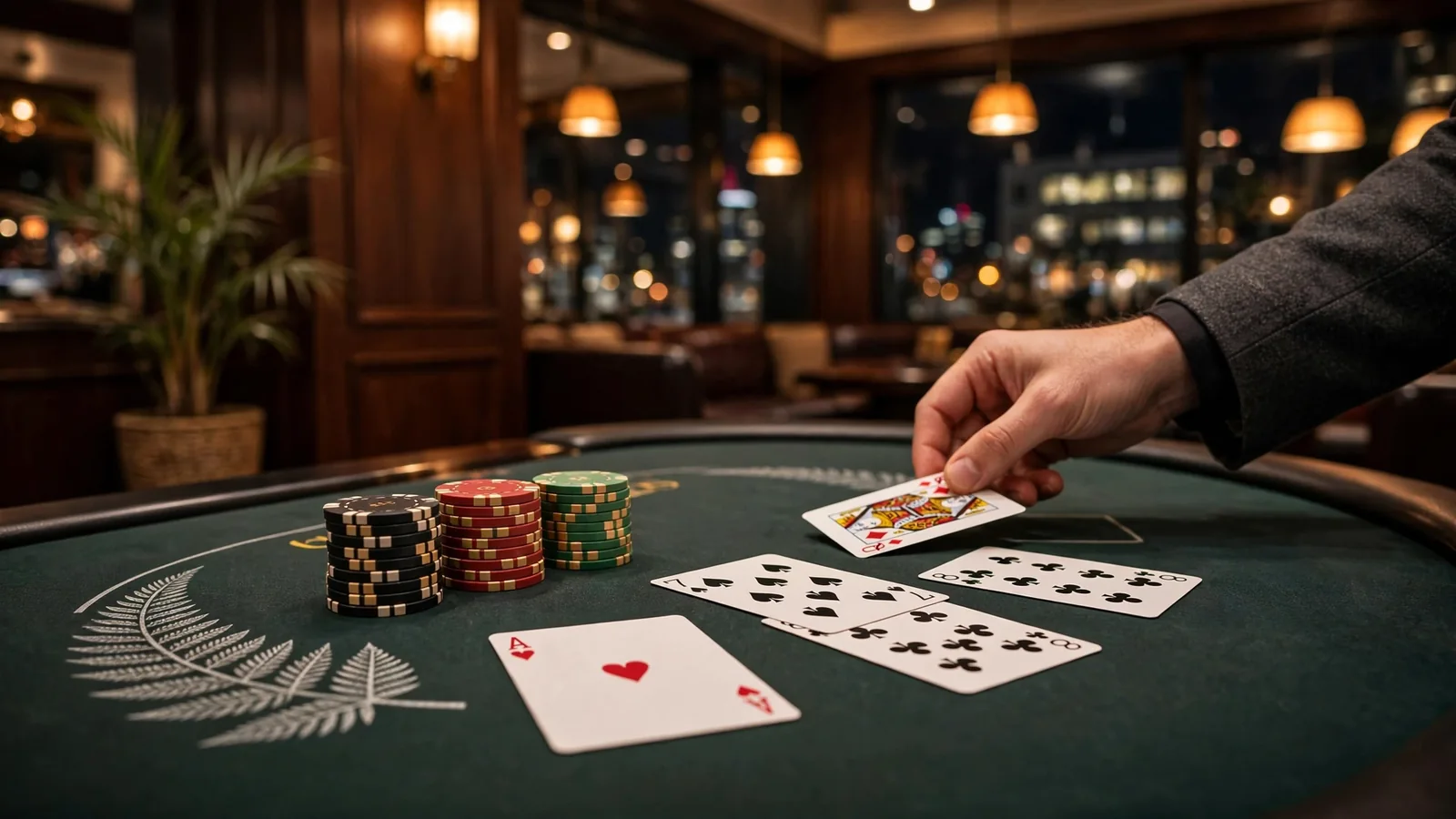
Table of Contents
- The Deal, the Total and the Dealer
- Free Online Blackjack: What the Simulator Does
- Free Play for Fun, Without a Live Table
- Online Casino Blackjack and New Zealand’s 2026 Licensing Framework
- Strategy Starts with the Table Rules
- Playing with Others and the Limits of Card Counting
- A Blackjack Game Is Still Dealer Against Players
- The Decisions That Shape a Blackjack Hand
- A Beginner’s Starting Point: Cards and Table Actions
- Betting and Playing More Than One Hand
The Deal, the Total and the Dealer
Blackjack is a hand-by-hand contest against the dealer, not a competition to match other players’ totals. The aim is to finish nearer to 21 than the dealer without going over. A hand above 21 is a bust and cannot win, even if the dealer later busts too. That makes each decision a balance between improving a total and avoiding a total that has already crossed the limit.
Reading the cards
Number cards count at face value. A face card—jack, queen or king—is worth 10. An ace can count as either 1 or 11, depending on which value makes the hand work best without exceeding 21. That flexibility is why an ace can change the character of a total as the hand develops.
A hand with an ace counted as 11 is commonly called a soft hand. If the ace must count as 1 to keep the total within 21, the hand is hard. For instance, an ace with a 6 can be valued as 7 or 17; another card may make the higher reading impossible, at which point the ace is treated as 1. The card itself has not changed. Only its useful value has.
Choosing a place to play blackjack online involves considering the information available about each operator. This list provides a concise reference to help New Zealand players review the options.
License: Tobique Gaming Commission, licence no. 0000064 Neospin lists a licence from the Tobique Gaming Commission, licence no. 0000064.
License: Malta Gaming Authority, licence no. MGA/B2C/370/2017 Play Grand lists a Malta Gaming Authority licence, no. MGA/B2C/370/2017.
License: Tobique Gaming Commission, licence no. 0000091 7Bit Casino lists a licence from the Tobique Gaming Commission, licence no. 0000091.
Payout speed: 1-3 business days Wintino lists a payout speed of 1–3 business days.
Payout speed: 1-3 business days Lamabet lists a payout speed of 1–3 business days.
License: Tobique Gaming Commission, licence no. 0000002 Ricky Casino lists a licence from the Tobique Gaming Commission, licence no. 0000002.
License: Malta Gaming Authority, licence no. MGA/B2C/394/2017 N1 Casino lists a Malta Gaming Authority licence, no. MGA/B2C/394/2017.
License: 07017519840 · Payout speed: 1-3 business days Zotabet lists licence number 07017519840 and a payout speed of 1–3 business days.
License: Curaçao Gaming Authority, licence no. OGL/2024/165/0185 BitStarz lists a Curaçao Gaming Authority licence, no. OGL/2024/165/0185.
A total is the sum of the cards under the values that keep the hand valid. The practical task is not to make every hand reach 21. A lower total can still beat the dealer if the dealer goes over, while a total of 21 is not a win if the dealer also has a hand that ties it. The outcome depends on both sides of the table.
A natural blackjack is a two-card hand consisting of an ace and a 10-value card. It is distinct from reaching 21 after taking additional cards, and the distinction can affect the payout. A specialist review reports that some tables pay a natural at 3:2 and others at 6:5; those terms should be read from the specific table rather than treated as a fixed rule. The arithmetic is straightforward: the ratio determines the return relative to the original stake, so a different ratio changes the amount paid for the same result.
What happens during a hand
The player receives cards and the dealer has a hand of their own. At the player’s turn, the available basic actions are hit, stand, double down and split, subject to the table’s rules.
A hit adds another card to the hand. It can improve a low total, but it can also push the total above 21. A stand ends the player’s turn with the current cards. The dealer then completes the dealer hand according to the game’s rules, and the two totals are compared.

Doubling down means increasing the stake for the hand and taking a further card under the conditions set by the table. It is a consequential choice: the stake changes, and the player’s opportunity to add cards is restricted by the action. The precise conditions are not identical across every game, so the displayed rules matter before the action is selected.
A split is available when the first two cards have the same value under the table’s pairing rules. The cards are separated into two hands, each played independently. That creates two outcomes rather than one, and the stake attached to the play changes accordingly. The table rules determine whether a particular pair can be split and what follows after the split.
These actions are not interchangeable. Hitting keeps the hand open but risks a bust; standing fixes the player’s total; doubling changes the stake as well as the next card opportunity; splitting turns one hand into two. The choice is made against the total already showing and the dealer’s visible card, within whatever options the table permits. This is the working meaning of blackjack rules at a casino: card values establish the total, the actions shape the hand, and the dealer’s final total determines the result.
Before play for money, the stake and the table’s terms are part of the calculation, not decoration. A bonus may carry wagering requirements, and blackjack may contribute differently from other games; maximum-bet rules can also apply while those requirements are being met. Fine print and bonus conditions should therefore be checked on trustworthy sites and casino pages before real-money play. A budget set in advance gives the session a defined stopping point, and losses are not a reason to raise it. No playing method changes the underlying comparison between the player’s hand and the dealer’s.
Attention: Bonus wagering requirements and maximum-bet rules can affect blackjack play; these conditions should be checked on trustworthy sites before real-money play.
The basic sequence is compact: cards produce a total, the player chooses among the permitted actions, and the dealer’s hand is compared with it. The detail that matters most at the table is the actual rule set in force. A familiar label does not guarantee identical terms, particularly for payouts and available actions. For anyone learning how to play blackjack in New Zealand in 2026, the sound starting point is to read those terms, identify the total and understand what each action commits before making it.
Free Online Blackjack: What the Simulator Does
An online RNG blackjack game replaces a physical deck and shuffle with software. The game’s random number generator determines the cards shown on screen, while the interface presents the hand and accepts the player’s decisions. The result is a digital simulation of blackjack rather than a view of a dealer handling cards at a table.
That distinction explains the pace. Software can move from one hand to the next without the pauses involved in dealing and handling physical cards, so RNG games generally run faster than live-dealer games. The shorter interval between hands is a feature of the format, not evidence that the decisions have less consequence within a hand. Each round still follows the game’s rules; the difference is how the cards are produced and displayed.

The software shuffle and the on-screen hand
In a simulated game, the shuffle is performed by software. There is no physical deck for the player to see being mixed, cut or dealt. Instead, cards appear on the screen as the game progresses. The interface is the visible layer; behind it, the game uses an RNG and software shuffling to produce the card sequence.
This also means that an online blackjack table can be opened and played through a browser or an app, depending on the game. Some versions require a download and others may run without one. That is a delivery choice, not a change to the underlying RNG format: in either case, the cards are generated digitally rather than dealt by a live dealer.
The screen may show the dealer’s area, player positions, cards and controls in a table-like layout. Those visual elements make the format recognisable, but they do not turn it into a filmed casino table. A graphical dealer or animated cards remain part of the software presentation. The defining feature is the software shuffle, not how closely the artwork resembles a physical casino.
Why RNG games move faster
A live table must accommodate the actions of a dealer and the physical movement of cards. An RNG game does not have those steps, so the software can present the next part of a hand as soon as the game is ready. This makes it possible to play blackjack online at a quicker rhythm than a live-dealer format.
Unlike live-dealer games, RNG blackjack eliminates the pauses involved in physical dealing, allowing for a quicker rhythm and more frequent transitions between hands.
The practical effect is more frequent transitions between hands. That may suit someone who wants a compact digital interface and does not need to watch a dealer handle cards. It also makes the pace easier to control in some games: the player can decide when to begin another hand rather than waiting for a live table to finish its round. The exact controls depend on the game, so the interface itself should be checked before play rather than assumed to work the same way everywhere.
A faster sequence can make sessions feel shorter while still containing more hand decisions in the same period. That is a simple pace calculation, not an advantage in the game. Faster play does not improve the cards or change the rules; it changes how quickly rounds are presented.
What “online blackjack” means in this format
A search for a blackjack game online can lead to different types of presentation. RNG blackjack is the software-based version: the shuffle and card sequence are handled digitally. Live-dealer blackjack uses actual cards and a streamed table, so it operates at a different pace. The two formats share the blackjack framework, but the way a hand reaches the screen is not the same.
For a player learning the interface, the simulated format makes the sequence visible without requiring a connection to a live table. The display can show what is happening as each card appears, and the controls are part of the same screen. That can make the mechanics of the software easy to follow. It does not, by itself, explain every table rule or settle which decision is appropriate; those depend on the specific game and are separate from the RNG process.

Likewise, “free online blackjack” can describe a game’s access mode, while “RNG” describes how its cards are generated. Those terms answer different questions. A free mode does not make a game live, and an RNG label does not mean that the game is being streamed. The useful distinction is between the digital shuffle and a dealer handling physical cards.
Reading the format accurately
The main point is modest: RNG blackjack uses software shuffles and generally moves faster than play with a live dealer. The screen may imitate a table, but the cards are generated through the game’s software. Anyone comparing formats is therefore comparing both presentation and pace, not just the appearance of the cards.
A digital interface can be convenient for moving through hands, but speed is not a measure of quality or a promise about outcomes. The simulator provides a software-run blackjack experience; its defining feature is how it produces and displays cards. The live table provides physical dealing, with the stream and dealer setting the rhythm. Keeping those formats distinct makes the term “online blackjack” more precise.
Free Play for Fun, Without a Live Table
Free-play blackjack gives a hand the shape of a casino game without putting money on the outcome. It can be used to get a feel for the pace, follow the sequence of decisions and see how a chosen action changes what happens next. The point is the experience, not a return: a result in a free game does not create winnings or establish what would happen at a paid table.
That distinction matters because the screen can look much the same whether a game is free or played for money. The interface may show cards, controls and a running hand total in either mode, but the financial terms are different. In free play, no stake is placed and a win is not a cash balance. A display that resembles a casino account is not, by itself, evidence that a free result can be withdrawn.
A free game can suit someone who wants to play blackjack for fun without arranging a live table or committing funds. It allows play to stop when convenient and keeps the activity separate from a money decision. That makes it useful as entertainment or familiarisation, but it does not reproduce every part of a real-money session. In particular, it does not show how it feels to have an actual stake exposed to each decision.
Some free games run directly in a web browser, so there may be no separate application to install. Availability depends on the game and the site hosting it; “no download” describes the access method, not a guarantee that every version works on every device. A browser game may still need a connection and may offer its own settings. If sound is available, it can often be enabled or muted within the game, but audio is an interface feature rather than a condition of play.
The absence of a live dealer is the main difference from a live-table format. A free game may present cards through a digital interface, while live-dealer blackjack uses actual cards handled at a casino table and shown through a stream. That can make the live version feel closer to being at a physical table, but it also ties the pace to the broadcast. Streaming may introduce delays, and live tables may require higher bets. Free play avoids those particular table conditions because it is not a streamed session with a dealer handling cards.
The formats therefore serve different purposes. Free play offers a low-pressure way to spend time with blackjack’s interface and rhythm. Live play adds a human dealer, physical cards and the timing of a broadcast, alongside the possibility of a higher required stake. Neither label alone says everything about a game: the displayed rules and available features still depend on the specific version.
A sensible boundary is to treat free results as entertainment rather than evidence of future performance. A run of favourable outcomes costs nothing in free mode, but it does not turn into a forecast for paid play. Likewise, a poor run does not carry a monetary loss. The difference is unusually clear: no stake means no financial result to calculate.
Free play is best understood as its own format, not as a promise of a live-table experience at no cost. It can provide the cards, controls and sound of a digital game where those features are offered. It does not provide a streamed dealer, actual cards in view or the conditions attached to a live table. That is enough for casual play; it is not the same product with the price removed.
Online Casino Blackjack and New Zealand’s 2026 Licensing Framework
The legal position behind online casino blackjack in New Zealand changed with the Online Casino Gambling Act 2026, which came into force on 1 May 2026. It creates the country’s first domestic licensing system for online casino gambling. That does not mean every website offering blackjack is licensed under the new framework, or that the full system is already operating.
Legal Compliance
Providers that have not applied for a licence must stop conducting online casino gambling in New Zealand by 1 December 2026.
The Gambling Act 2003 does not permit online casinos to be based in New Zealand. Before the 2026 Act, overseas online casino services were not licensed or supervised by a New Zealand regulator. Customers who wagered on those sites had no domestic government recourse. The new law changes the framework, but not all at once: the full licensed regime is not expected to be operational until 2027.
Two regulators, different responsibilities
The Department of Internal Affairs is New Zealand’s primary gambling regulator and oversees regulation of the online casino licensing framework. The Gambling Commission has the decision-making role in licensing. It hears and determines casino licensing applications, issues online casino licences and approves changes to licence conditions.
Those functions should not be treated as interchangeable. The Department’s oversight does not itself amount to a licence for a particular blackjack site. Licensing decisions and changes to licence conditions sit with the Commission. A website’s claims about its own status therefore need to be read against the legal framework, rather than treated as proof.
The Act also establishes a transition period from 1 May 2026 to 1 December 2026. Online casinos that were already serving people in New Zealand before the Act began may continue during that period, subject to the transitional provisions. This is a temporary permission to continue, not confirmation that every such provider has received a domestic licence. Providers that have not applied for a licence must stop conducting online casino gambling in New Zealand by 1 December 2026. Unlicensed operation is expected to become an offence from around mid-2027.
That distinction matters when comparing sites for blackjack, including live-dealer services or options that allow friends to join a game. A familiar interface, a live stream or a shared table does not settle the licensing question. During the transition, online casino operators are prohibited from advertising to people in New Zealand. Licensed operators may advertise under tight rules once the regime permits it, while sponsorships are prohibited.
What licensing does—and does not—tell a player
A licence addresses whether an operator is authorised under the domestic system and subject to its conditions; it does not turn a bonus into a favourable deal or make a blackjack outcome predictable. Any offer involving casino blackjack should be assessed through its written terms, including wagering requirements and maximum-bet rules during wagering. Blackjack may contribute differently to wagering requirements than other games, so the headline offer alone does not show the amount of play required.
Likewise, advice framed as a professional method does not replace the terms governing a game or an operator’s legal status. The practical sequence is less glamorous: identify whether the provider falls within the transition rules or holds the relevant licence once licensing is available, then assess the conditions attached to play. The legal framework provides oversight; it does not remove the need to calculate the offer.
Strategy Starts with the Table Rules
A blackjack strategy is only a set of decisions matched to a particular set of rules. Change the rules and the value of some decisions changes with them. A strategy chart built for one game may therefore be a poor fit for another, even when both tables use the same familiar name.
Natural blackjacks may pay 3:2 or 6:5, which directly affects the return relative to the original stake.
The number of decks used influences the likelihood of outcomes and determines which strategy chart is appropriate.
Determines whether the dealer must hit or stand on a hand containing an ace counted as 11 totalling 17.
An optional rule that allows a player to end a hand early under specific table conditions.
A specialist review describes natural-blackjack payouts of 3:2 and 6:5. The difference affects the return on a hand that begins with an ace and a ten-value card; it is not a cosmetic detail in the table description. The same review notes that games can vary in deck count, whether the dealer hits or stands on soft 17, and whether surrender is available. These conditions alter the decisions a player faces and can affect both strategy and house edge.
Deck count matters because the composition of the remaining cards influences the likelihood of different outcomes. A strategy based on one deck configuration should not be treated as automatically interchangeable with one prepared for another. The practical check is to identify the game’s deck setup before relying on a chart, rather than assuming that a blackjack label guarantees identical conditions.
Soft 17 is another rule that needs to be read precisely. It describes a dealer hand containing an ace counted as 11 and totalling 17. If the dealer must draw on that hand, the game proceeds differently from one in which the dealer stands. The rule changes the dealer’s possible outcomes, so the appropriate strategy reference must account for it.
Surrender also affects the calculation. Where it is allowed, it gives a player an option to end a hand under the table’s stated conditions. Where it is absent, that option is not part of the decision set. A strategy that recommends surrender cannot be followed at a table that does not permit it; the rule is a condition, not a suggestion.
The best way to approach blackjack strategy is therefore to match it to the game in front of the player: payout, deck count, soft-17 rule and surrender availability first, then the recommended decisions. A table with a less favourable payout or different dealer rule may require a different strategy reference, and its house edge may differ from that of another variant. No chart removes that underlying cost or guarantees a winning session.
Before play, the written rules and the game’s displayed information should be checked together. If the table does not clearly state a condition, a strategy that depends on it cannot be applied with confidence. The small print is part of the game mathematics; ignoring it does not simplify the calculation, it merely leaves an assumption in its place.

Playing with Others and the Limits of Card Counting
Blackjack can be played by two people at the same table. Each player makes decisions on their own hand, while the dealer’s hand is the common point of comparison. In an online multiplayer game, other players may be visible or represented at the table, but their presence does not turn the game into a team hand: each player’s result is assessed separately against the dealer.
The pace and layout depend on the game. A shared table can make play feel social, while a solo game keeps attention on one seat. Neither format changes the basic relationship between a player and the dealer. Other players’ choices may be observable, but they do not give another player control over a hand or determine its result.
Card counting is a separate subject from multiplayer play. It refers to keeping a mental count based on cards that have already appeared, then using that count to assess the remaining mix. Under New Zealand law, card counting performed through mental calculation is not illegal. That legal point is narrow: it does not establish that a particular operator permits every method of play, nor does legality itself demonstrate that a counting approach will produce an advantage.
Online games introduce a different limitation. RNG blackjack uses software shuffles, unlike a live table where actual cards are dealt. A claim that card counting works online would need to account for how the software handles the cards; the presence of a multiplayer screen does not create a continuous, observable sequence that supports the same reasoning as tracking cards at a physical table. Software marketed as card-counting assistance cannot change the underlying shuffle process. Its label is not evidence that it can identify a useful count in an RNG game.
This distinction matters when evaluating card-counting software for online play. The relevant question is not whether a tool can display numbers or analyse a screen, but whether the game provides a persistent card sequence for those calculations to use. Where software shuffles are automatic, claims of effectiveness should not be treated as established simply because the interface shows other players or previously dealt cards.
Multiplayer play is therefore a format choice, while card counting is a method with legal and practical questions of its own. The law’s position on mental calculation does not validate online software claims; the game’s shuffle mechanics remain the decisive limitation.
A Blackjack Game Is Still Dealer Against Players
Blackjack is a contest between each player and the dealer, not a competition in which the table’s players try to beat one another. The shared target is to finish with a hand closer to 21 than the dealer’s hand, without exceeding 21. A hand that goes over that limit cannot meet the objective, even if the dealer later finishes with a higher total.
That relationship is the basic frame for any play blackjack game, whether the table is busy or a player is taking part alone. Other people may be making decisions at the same table, but their totals do not set the result of an individual hand. Each player’s outcome is assessed against the dealer.
The number 21 acts as a boundary, not a score that must be reached exactly. A total below 21 can still be enough if it is nearer to the limit than the dealer’s total. Conversely, getting close is not useful if the hand passes the boundary. The comparison has two parts: the player must stay within 21, then finish ahead of the dealer’s result.
This also explains why the dealer matters more than the apparent activity around the table. Players can see one another’s hands and choices, but the central comparison remains unchanged. A player does not win merely because another participant has a weaker hand, and a table full of players does not create a shared result. The dealer is the common opponent; the outcome is determined separately for each player.
A casual blackjack game may look like a sequence of cards and decisions, but its purpose is compact: manage a hand against the dealer’s hand while respecting the 21 limit. The details of how a player responds during the hand affect that comparison, yet they do not change the objective. Nor does the aim require matching the dealer’s total exactly. It is enough to finish closer to 21, provided the hand has not gone over.
That simple structure is what makes blackjack recognisable across different tables and formats. Rules can change the available decisions or the settlement, but the central contest stays dealer against player: approach 21 without crossing it, then compare the result with the dealer’s.
The Decisions That Shape a Blackjack Hand
A hand develops through choices made after the initial cards are dealt. The available actions determine whether play continues, the stake changes, or the hand ends early. The table’s rules set the boundaries: hitting, standing, doubling down and splitting are standard options, while surrender may be offered only at some tables.
Hitting requests another card. It can improve a total, but it also creates the possibility of going over 21 and losing the hand. The decision is not simply whether another card would be welcome; it is whether the potential improvement is worth the added risk. A hand’s current total matters, as does the dealer’s visible card, but no action removes uncertainty about what comes next.
Standing ends the player’s turn without taking another card. The hand’s existing total is then left to compete with the dealer’s final total. Standing avoids the risk of taking a card that pushes the hand over 21, but it also gives up the chance to improve a weak total. It is a decision to accept the current position, not a guarantee that it will be sufficient.
Doubling down changes the stake in return for a restricted continuation of the hand. In the usual form, the player doubles the wager and takes one more card, then stands. Because the commitment is larger and the hand cannot continue with further hits, the table’s specific doubling rules matter. A decision that appears straightforward can have a different cost if the permitted circumstances or mechanics vary.
Splitting turns a pair into two separate hands, each played in its own right. This creates a second result to resolve and can require an additional stake. It does not make the original hand safer by itself: each new hand has its own outcome, and both remain exposed to the cards dealt.
Surrender may allow a player to give up a hand under the conditions set by the table. Its availability and timing are not universal, so the rule should be understood before play begins. The practical distinction is between continuing with a hand and accepting the table’s permitted early exit.
These choices are not interchangeable buttons. Each changes the hand’s exposure, duration or stake, and the rules determine which options are actually available.
A Beginner’s Starting Point: Cards and Table Actions
A blackjack hand is easier to follow once each card has a value. Number cards count as the number printed on them. Picture cards—jacks, queens and kings—each count as ten. An ace is flexible: it can count as one or eleven, depending on which value works for the hand without taking it over the limit.
Card Value Calculation
Number cards are counted at their face value.
Jacks, queens, and kings are each assigned a value of 10.
Assign the ace a value of either 1 or 11, depending on which total best serves the hand without exceeding 21.
The total is the sum of the cards in a hand. Because an ace can change value, the same cards may be counted in more than one way. That flexibility is part of the basic arithmetic, not a separate bonus. A hand with an ace is often described as soft when the ace is being counted as eleven; if that value would make the total too high, the ace can count as one instead.
The aim is to finish closer to twenty-one than the dealer without going over. A player does not need specialist equipment to understand the game: the essential parts are a hand, its running total and the choice of what to do next. The available actions are described by short table terms:
- Hit: take another card and add its value to the hand.
- Stand: keep the current hand rather than take another card.
- Double down: increase the wager and take one further card, where the table permits the action.
- Split: separate a qualifying pair into two hands, subject to the table’s rules.
These choices do different things. Hitting changes the total; standing leaves it as it is. Doubling down and splitting alter how the hand is played as well as the wager involved. Their availability and conditions are set by the table, so the labels alone do not establish when they can be used.
For a beginner, the useful routine is simple: identify each card’s value, keep track of the total, and understand what each action changes. The ace deserves particular attention because its value can shift. No betting system is needed to learn those mechanics. Blackjack becomes legible when the cards are counted consistently and each decision is understood in terms of its effect on the hand.
Betting and Playing More Than One Hand
A blackjack session involves two separate decisions: how much to stake and how many hands to play. A second hand adds another wager to the same round; it does not make the first hand safer or change the value of its cards. The result of each hand is settled against the dealer, so a round with multiple hands can produce different outcomes across those hands.
The table rules determine which decisions are available after the cards are dealt. Depending on the game, a player may hit, stand, double down, split or surrender. Those options affect how a wager is used: doubling down changes the stake on a hand, while splitting turns a pair into separate hands that require separate decisions. The displayed rules should be checked before play, particularly when a hand is split or doubled, because the permitted actions depend on the table.
A blackjack bet-and-play simulator can help show how a chosen stake and number of hands affect the flow of a round, without putting money at risk. It can also make the added exposure from playing two hands easier to see: both wagers are in play, and each hand can lose independently. A simulated result does not establish what a later round will return.
More hands create more decisions and can make the session’s total stake less obvious if attention stays on each individual hand. A budget should therefore be set before play, with the total amount at risk kept in view. Increasing stakes to recover losses is not a reliable correction; it adds exposure without changing the rules or guaranteeing a better result.
Where real-money play involves a bonus, the terms matter as much as the table. Blackjack may contribute differently to wagering requirements, and maximum-bet rules may apply while wagering conditions are active. The fine print on trustworthy sites and casinos should be checked before play, since a stake that breaches a condition can affect whether the bonus qualifies.
The practical comparison is not simply one hand against two. It is the total stake, the actions permitted by the table, and any applicable bonus conditions. A betting system cannot remove those terms or guarantee a profit.
Published by the Casino Slots Tips NZ team.