Free Blackjack in New Zealand: Rules and Practice
 Available in US
A practical guide to hand totals, free-play formats, simulator testing and the terms attached to no-deposit offers.
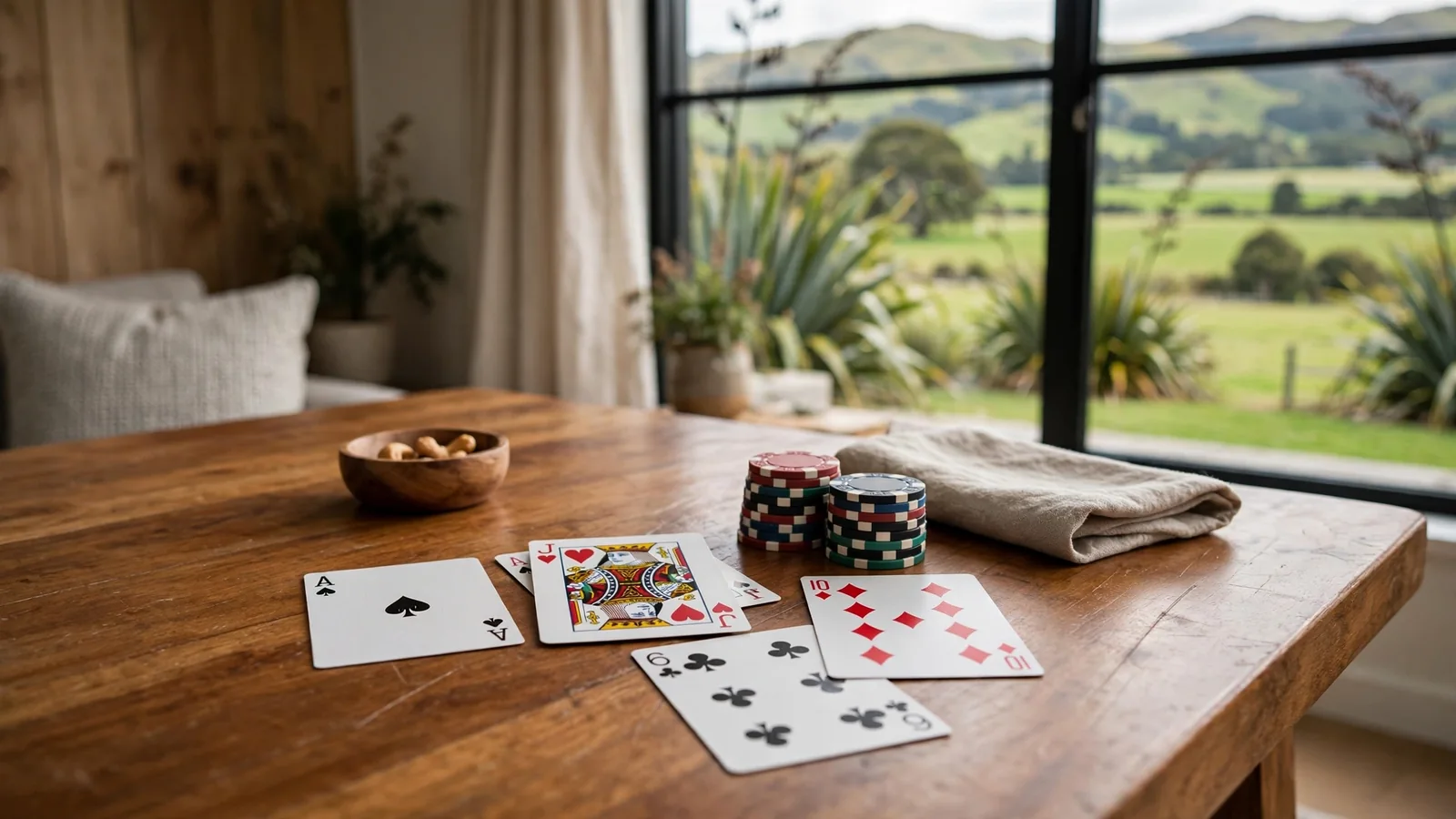
Table of Contents
- The Blackjack Rules Behind Every Free Game
- Free Play, One Hand at a Time
- Free Bets and the Payout Terms That Matter
- Playing for Fun: RNG or Live Dealer
- Free Blackjack Online in New Zealand: The 2026 Licensing Context
- No-Download Games and Unblocked Access
- Blackjack Simulators for Testing a Hand
- No-Deposit Blackjack: Read the Money Terms Literally
- Practice Strategy, Rule Variations and Card Counting
The Blackjack Rules Behind Every Free Game
Blackjack is a contest between each player’s hand and the dealer’s hand. The target is a total closer to 21 than the dealer’s, without going over 21. The number to keep in view is therefore not a score to exceed: a hand that passes it has gone beyond the game’s limit.
The arithmetic is straightforward once each card’s value is clear. Number cards count at face value, so a seven adds seven and a two adds two. Jacks, queens and kings each count as ten. An ace is flexible: it can count as either one or eleven. That choice lets the same card fit more than one useful total, depending on the rest of the hand.
Adding a hand
A hand total is the sum of its cards, with an ace counted in whichever way keeps the hand within the most useful range. For instance, an ace with a six can total either seven or seventeen. The ace is not permanently fixed at eleven; if counting it that way would take the hand past 21, counting it as one keeps the total within the limit.
This flexibility matters when more cards are involved. An ace, six and four can be counted as eleven or twenty-one: the ace contributes one or eleven, while the other cards contribute their face values. The total of twenty-one is still within the target. If another card were added, the ace could be treated as one instead, where that produces a valid total. The total depends on the cards present, not on a fixed value assigned to the ace at the start.
A hand containing an ace that can count as eleven without taking the total above 21 is often described as a soft total. The term refers to the ace’s adjustable value, not to a special kind of card. A hard total has no ace counting as eleven, either because there is no ace or because the ace must count as one to keep the hand within 21. For basic arithmetic, the distinction is useful: a soft total can change when the ace is valued differently, while a hard total has no such adjustment available.
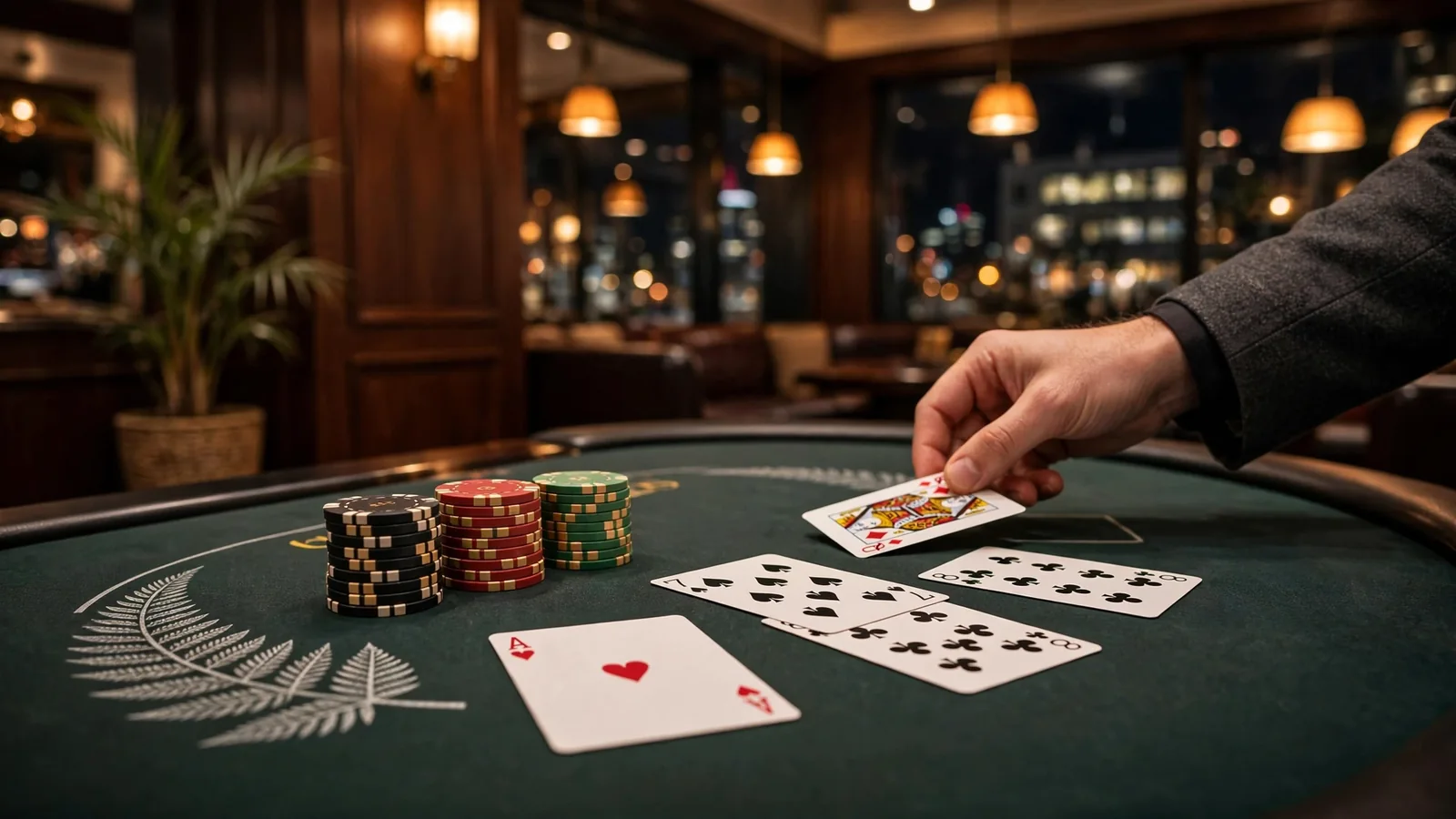
Consider a king and a five. The king counts as ten, so the hand totals fifteen. Add a three and the total becomes eighteen. By contrast, an ace and a king total twenty-one, because the ace can count as eleven alongside the king’s ten. These examples use the same addition as any other hand; only the ace requires a choice between its two values.
The dealer is the comparison
A player does not need to make the highest total possible in isolation. The relevant comparison is with the dealer’s hand. A total near 21 can be strong if it remains within the limit, but a total beyond 21 fails that central condition, regardless of how close it was beforehand. The dealer is not an abstract target: each player’s result is measured against the dealer’s result.
This makes the order of the basic ideas important. First, add the cards using their stated values. Next, account for any ace that could count as one or eleven. Then consider the 21 limit and the dealer’s total. A hand of twenty is closer to 21 than a hand of sixteen, but blackjack is not simply a race to build the largest number. Going over the limit changes the result.
The same arithmetic applies whether the cards are dealt through a free blackjack game or another version of the game. A free casino blackjack game still needs to show the cards clearly enough for the hand total to be understood; free play does not change what a king or ace means. The distinction is between the format in which a game is offered and the rules used to count a hand. The card values remain the starting point for following the action.

A natural blackjack refers to an ace and a ten-value card as the opening hand. Its total is 21, reached with those two cards. The arithmetic is uncomplicated, but its treatment at the table is a separate matter from adding the total: a stated payout can depend on the table’s terms. The hand’s value is still twenty-one; the amount returned is not part of the card calculation.
For anyone learning with free blackjack card games, the useful habit is to total the hand before judging it. Face cards contribute ten, number cards contribute their printed value, and an ace contributes one or eleven as the hand requires. Once that sum is clear, the purpose of the round follows: finish nearer to 21 than the dealer without exceeding the limit. Everything else in a hand builds on that comparison.
Free Play, One Hand at a Time
A free-play hand is useful for observing decisions in sequence, rather than treating blackjack as a single choice between taking another card and stopping. The player acts on the hand already dealt, selects an available action, then responds to the next state of play. The same four core choices recur: hit, stand, double down or split. Each changes what can happen next, so a practice session is more informative when the action is considered in context instead of selected by habit.
Hitting asks for another card. It can improve a hand that is not yet strong enough to stand, but it also brings the possibility of going over 21. A free session makes it possible to see both outcomes without making the decision appear costless in principle: the hand still has a consequence within the game, even if no real-money stake is involved. The point is to notice the trade-off. A hit is not automatically cautious because it adds information, and it is not automatically reckless because it adds risk. Its value depends on the hand and the table situation.
Standing ends the player’s choices for that hand. It leaves the current total as it is and transfers the next move to the dealer. This is a deliberate stopping point, not a way to improve the hand. In practice, the useful question is whether the current position is preferable to inviting another card. Repeated free hands make that comparison visible: a stand can hold a sound position, or preserve a total that proves insufficient. Neither outcome alone establishes that the choice was right or wrong; the decision has to be judged using the information available when it was made.
Doubling down changes the scale of the decision. The player commits to a larger stake and receives only one further card before the hand is complete. That makes it a more constrained action than hitting: there is no continuing choice after the additional card arrives. In a free-play setting, the feature can be tested as a decision rule without confusing the larger commitment with a promise of a better result. It is especially useful to notice whether the reason for doubling is tied to the hand and the table’s rules, rather than to a desire to recover from a previous loss. A free game can display the choice; it cannot make a weak reason sound stronger.
Splitting turns one hand into separate hands when the table permits the move. Instead of deciding how to continue with the original hand, the player now manages more than one outcome. That increases the number of decisions in the round and can change how much is committed to it. The action is not simply a way to discard an awkward hand: each resulting hand must be played, and its result is considered separately. Free practice can help make that extra sequence familiar, but the option and its details depend on the table.
Ask for another card to improve a hand, though it brings the risk of going over 21.
End the choices for the hand, leaving the current total to be compared with the dealer.
Commit to a larger stake for exactly one further card before the hand is complete.
Turn one hand into separate hands when permitted, managing multiple outcomes in one round.
These choices work best as a small decision record. Before acting, identify the hand, the dealer’s visible position and the action being considered. After the hand, review whether the choice followed a consistent reason. That review matters more than whether the round happened to end in a win. A sound decision can lose, while an impulsive one can succeed; one result does not settle the quality of the process.
A useful session can also isolate one kind of choice. Several hands can be played with particular attention to when a hit becomes a stand, then another stretch can focus on the commitment involved in doubling down or splitting. This is not a betting system and does not guarantee improvement. It simply makes the decision easier to inspect because fewer things are being tracked at once. If every action changes at random from hand to hand, it becomes difficult to tell whether a pattern reflects a reasoned choice or a reaction to the last result.
The pace of a session should leave room for that review. Playing quickly may produce more hands, but it can reduce each decision to a button press. Pausing briefly before an action helps separate the choice from the emotional pull of a recent outcome. Chasing losses has no useful role in practice: there is no need to make the next hand carry the burden of repairing the previous one. A sensible budget remains necessary whenever play involves money, and a free session should not be treated as evidence that real-money play will be profitable.
For two-player blackjack online free play, the same basic focus applies: the number of people at the table does not remove the need to decide what to do with each hand. Nor does a version labelled blackjack 21 free play make every action equivalent. A hand-by-hand approach keeps attention on the decision in front of the player, while leaving table-specific variations and strategy questions for separate consideration.
Free Bets and the Payout Terms That Matter
A free bet and a blackjack payout are different parts of the calculation. A free bet is promotional credit offered under stated conditions; the payout is what a winning hand returns under the table’s rules. The word “free” describes the source of the stake, not necessarily cash that can be withdrawn without restriction.
The first point to establish is what happens to the promotional stake when a hand wins. Some offers may return winnings while removing the free-bet stake; others may apply different terms. The offer’s wording decides which calculation applies. If the stake is excluded, a winning hand can produce less cash than a calculation that treats the promotional amount as an ordinary cash bet. A displayed win is therefore not enough to establish the amount ultimately available.
The next distinction is between the payout for a natural blackjack and the return for another winning hand. A natural is a two-card blackjack; its stated payout can differ from the ordinary return on a winning hand. A specialist review reports tables paying 3:2 on a natural and others paying 6:5. Those are reported table terms, not a dependable market-wide rule. The table’s own payout display is the relevant figure for the game being played.
The difference is material even when the wager is unchanged. At 3:2, a winning natural returns the stake plus winnings calculated at that ratio; at 6:5, the winnings are calculated at a lower ratio. The stake itself is not the profit. Reading only the headline ratio, without checking whether it applies to a natural blackjack or to another result, can give the wrong account of the hand.
At 3:2, a winning natural returns the stake plus winnings at that ratio, whereas at 6:5, the winnings are calculated at a lower ratio.
Promotional terms add another layer. A free-bet offer may be subject to wagering requirements, and blackjack may contribute differently from other games toward meeting them. Maximum-bet rules can also apply while wagering requirements remain active. These conditions affect the practical value of the credit: a nominally generous offer can have limited value if the eligible play, contribution rate or permitted bet size narrows how it can be used. The terms should be read together rather than as separate marketing claims.
“Exclusive” does not change the arithmetic. It describes how an offer is presented or made available, not the payout on a blackjack hand. The same distinction applies to a free-bet blackjack payout: the promotion governs the treatment of the credited stake, while the table governs the return on the result. Neither label replaces the other.
RTP is a separate measure again. It describes a game’s theoretical return over extensive play, not the amount paid on a particular hand and not the cash value of a promotional credit. A favourable-looking RTP cannot override a table’s stated natural-blackjack payout or an offer’s wagering conditions. For a single session, the payable result depends on the actual hand and the terms attached to both the game and the promotion.
The useful comparison is therefore between the promotional credit’s conditions and the table’s stated payout, not between headline offers alone. If either set of terms is unclear, the value cannot be calculated reliably.
Playing for Fun: RNG or Live Dealer
Free blackjack online for fun can use either a software-dealt game or a live stream. The difference is not merely visual. It changes the pace of a session and the kind of table experience on screen. A free-play option, where a game provides one, describes how the session is funded; RNG and live dealer describe how the cards are dealt.
In an RNG game, software shuffles the cards. Hands move more quickly because play does not wait for a dealer to handle physical cards or for a stream to catch up. That makes this format better suited to short sessions or repeated hands, where the point is to keep the game moving. The screen presents a digital table, and the pace is set by the software rather than by a person dealing in real time.
The same speed can make an RNG table feel less like a casino floor. Its focus is the game interface: a hand is dealt, the result appears, and the next round can begin without a live table’s pauses. Free blackjack games for fun in this format can therefore provide a straightforward way to experience the software version, if a free mode is available. The speed is a feature of the format, not evidence that a player will get a better result.
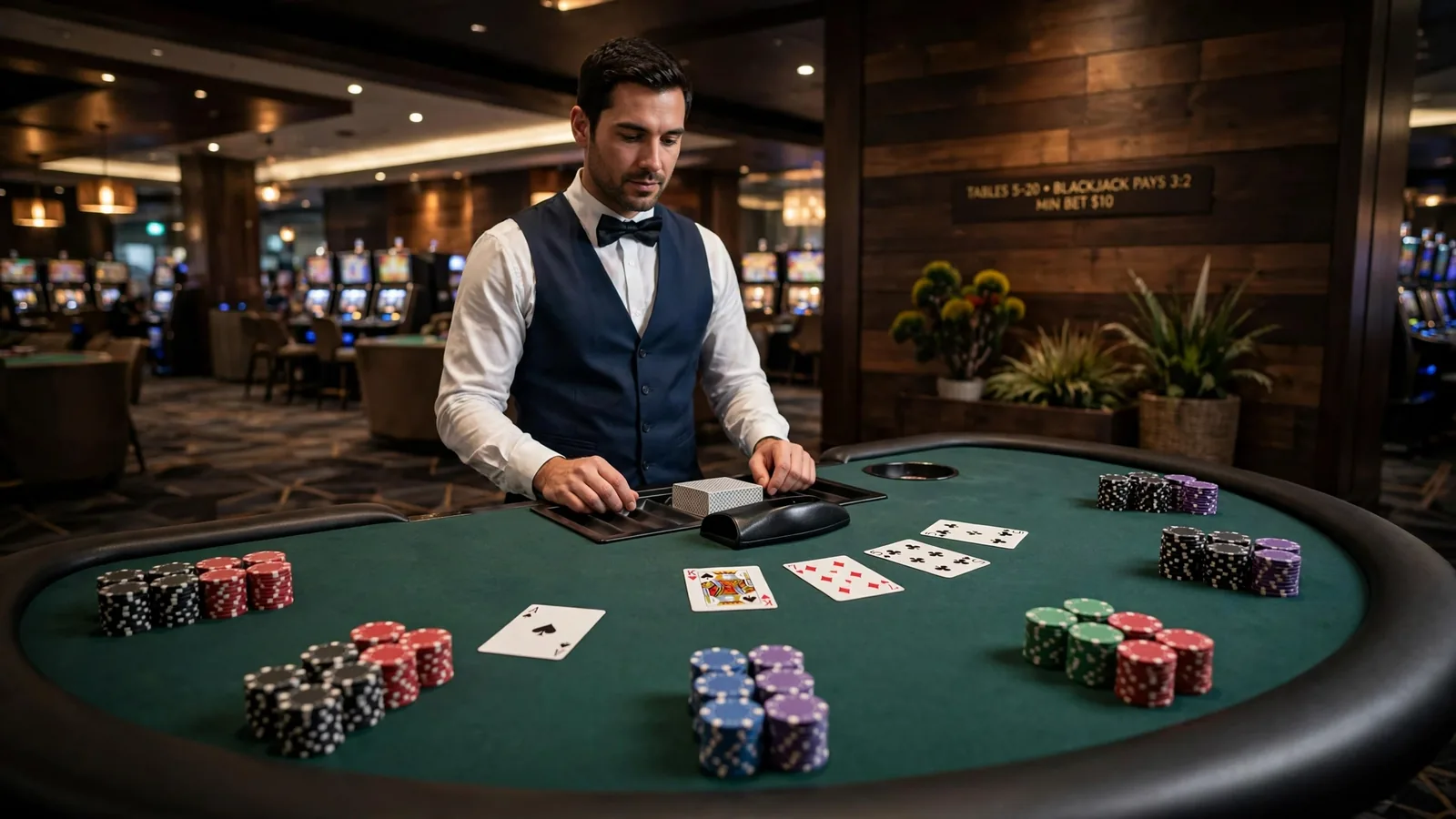
Live-dealer blackjack uses physical cards and a human dealer, with the table shown through a stream. The view is closer to sitting at a casino table: cards are handled in front of the camera rather than generated as an on-screen sequence. That can make the session feel more present, but it also puts the pace partly in the hands of the stream. Delays can interrupt the flow, so a live table is not automatically the quicker or more convenient choice.
- Use RNG blackjack for faster sessions
- Choose live dealer for a realistic casino impression
- Expect the same bet minimums for both formats
- Assume a live game is always available for free
There is also a practical cost distinction. Live-dealer games may require higher bets than software-dealt games. That matters when comparing formats even if the attraction is the streamed table rather than the amount in play. A free option should not be assumed simply because a live game appears in a casino lobby; availability depends on the game and the conditions shown for it.
“Multiplayer” can describe the social or shared-table presentation, but it does not by itself establish that a game is free. An online blackjack game with multiplayer features may still have its own access and bet conditions. The format label, the presence of a dealer, and whether a free-play mode is offered are separate details. Each needs to be read on its own rather than inferred from the others.
For a session built around speed, RNG blackjack is the more direct fit: software shuffles support faster hands than streamed dealing. For a session built around the sight of actual cards and a dealer, live play offers the closer table impression, with streaming delay and potentially higher bets as the trade-off. Neither format changes the basic purpose of free play: the entertainment is in the session, not a promise of winnings.
Free Blackjack Online in New Zealand: The 2026 Licensing Context
If you’re looking for free blackjack in New Zealand in 2026, use this list as a starting point for checking which operators may suit your needs. Review each operator’s available details before choosing where to play.
License: Tobique Gaming Commission, licence no. 0000064 Neospin lists a licence from the Tobique Gaming Commission, licence no. 0000064.
License: Malta Gaming Authority, licence no. MGA/B2C/370/2017 Play Grand lists a Malta Gaming Authority licence, no. MGA/B2C/370/2017.
License: Tobique Gaming Commission, licence no. 0000091 7Bit Casino lists a licence from the Tobique Gaming Commission, licence no. 0000091.
Payout speed: 1-3 business days Wintino lists a payout speed of 1–3 business days.
Payout speed: 1-3 business days Lamabet lists a payout speed of 1–3 business days.
License: Tobique Gaming Commission, licence no. 0000002 Ricky Casino lists a licence from the Tobique Gaming Commission, licence no. 0000002.
License: Malta Gaming Authority, licence no. MGA/B2C/394/2017 N1 Casino lists a Malta Gaming Authority licence, no. MGA/B2C/394/2017.
License: 07017519840 · Payout speed: 1-3 business days Zotabet lists licence number 07017519840 and a payout speed of 1–3 business days.
License: Curaçao Gaming Authority, licence no. OGL/2024/165/0185 BitStarz lists a Curaçao Gaming Authority licence, no. OGL/2024/165/0185.
A free blackjack game is still part of the online casino environment; the absence of a stake does not, by itself, establish that a provider holds a New Zealand licence. The legal framework changed in 2026, but the change is being introduced in stages. That distinction matters when considering free casino blackjack or other online casino games during the transition.
The Online Casino Gambling Act 2026 took effect on 1 May 2026 and created New Zealand’s first domestic licensing system for online casino gaming. Before that date, the Gambling Act 2003 barred online casinos from being based in New Zealand. Gambling offered online from overseas was not licensed or supervised by a New Zealand regulator, and customers using those sites had no domestic government recourse.
The new Act does not mean that every online casino immediately moved into a fully operational licensing system. Its transitional window began on 1 May 2026 and runs until 1 December 2026. Providers that were already offering services to people in New Zealand before the start of that window may continue during it, subject to the Act’s transitional provisions. This is a temporary continuation arrangement, not proof that a provider has received a domestic licence.
The transition also sets a boundary for providers seeking to enter the new regime. A provider that has not applied for a licence must stop conducting online casino gambling in New Zealand by 1 December 2026. If an application is declined, the provider must cease its online casino operations in the country and leave the market. The complete licensed system is not expected to be operational until 2027, while unlicensed operation is expected to become an offence around mid-2027.
The Department of Internal Affairs is New Zealand’s primary gambling regulator and oversees regulation of the online casino licensing framework. The Gambling Commission has a different, decision-making function: it hears and determines casino licensing applications, issues online casino licences, and approves changes to licence conditions. The responsibilities are related but not interchangeable. Oversight of the framework sits with the Department; decisions on applications and licence conditions sit with the Commission.
Licensing Transition
A provider that has not applied for a licence must stop conducting online casino gambling in New Zealand by 1 December 2026.
For anyone comparing blackjack online for free, the practical point is that a game’s no-cost format does not answer the licensing question. Nor does the transitional permission mean that an operator has already passed through the new licensing process. The relevant status depends on whether the provider falls within the transitional provisions and, as the new regime takes effect, on the outcome of its licensing application.
Licensed operators will have to meet stricter age and identity verification requirements. Advertising by licensed operators is permitted only under tight rules, and sponsorships are prohibited. During the transition, advertising to people in New Zealand is prohibited. Those restrictions form part of the wider framework; they do not turn a free game into a separate category of licence.
The new system therefore has a clear sequence: transitional continuation for qualifying existing providers, applications and decisions under the Commission, and a fuller licensing regime expected in 2027. The label “free” describes the game’s price to the player, not the provider’s regulatory position.
No-Download Games and Unblocked Access
A browser-based blackjack game runs through a web page rather than a separately installed application. That can remove the installation step, but “no download” describes one part of access, not the whole process. The game may still depend on the browser, device, connection and any conditions set by the service hosting it. A page that opens on one device may not behave the same way on another.
The same distinction applies to registration. A game may allow a session without creating an account, while another may ask for sign-in before showing its play options. The label “no registration” is useful only if it matches the actual route into the game. If a sign-in prompt appears before play begins, the session is not registration-free in practice. Claims about access should be checked against the page itself rather than inferred from a title or thumbnail.
Free blackjack can refer to more than one arrangement. It may describe a game played without a cash stake, but the word “free” alone does not establish whether an account is required, whether the game is available in a browser, or whether a download is involved. Those are separate conditions. A clear access description states them separately; a broad promise leaves the important details to be discovered after clicking.
For a browser game, the useful checks are practical. Does the page load without prompting for an installer? Does it open the game directly, or does it first require an account? Is the play mode clearly identified as free rather than cash wagering? If any of these points is unclear, the access claim has not yet been confirmed. No particular site or game can be assumed to meet all of them.

Software-dealt blackjack can suit a browser session where the aim is to get through hands without the pace of a streamed table. Online RNG games use software shuffles and can deal faster than live-dealer games. That explains the pace, not the access conditions: a faster game may still require registration or a download, while a browser page may load slowly because of the device or connection. “No download” and “fast play” are not interchangeable promises.
A downloadable game is a different choice. It may require software to be installed before play, so it does not meet a strict no-download preference. Before installing anything, the file’s source and the stated terms should be clear. A page that presents a download button does not, by itself, establish what the installer contains or what permissions it needs. If those details are not evident, there is no sound basis for treating the file as necessary or suitable.
Browser Access Check
- Verify the page loads without an installer
- Confirm no registration is required for play
- Ensure the play mode is identified as free
- Check if the page is accessible on the current network
“Unblocked” is also an access description, not a guarantee. A game may be unavailable on a particular network, device or browser even when a page is reachable elsewhere. Network restrictions can affect access, and the word does not show that a game will load in every setting. Nor does it establish that a particular route around a restriction is permitted. The meaningful question is whether the game is accessible through the ordinary browser and connection available for the session.
A sensible comparison therefore separates four points: installation, account creation, the meaning of “free”, and the ability to load the page. Each can have a different answer. A game may be free but require sign-in; browser-based but unavailable on a restricted network; or accessible without an account while still offering a separate download. Treating these labels as synonyms makes the conditions harder to see.
For a low-friction session, browser access may be preferable because it avoids installing a separate program. That is a convenience, not evidence about the quality or terms of the game. The page should identify whether play is free, and any prompt to register or download should be weighed against the original access claim. If the conditions change before the game opens, the practical offer has changed too.
Blackjack Simulators for Testing a Hand
A blackjack simulator provides a practice setting for examining decisions without treating a run of hands as a forecast. In a free simulator, the useful output is the sequence of choices and their consequences within the game, not a promise that the same choice will produce the same result next time.

A practice hand can be approached as a decision record. At each point, note the cards shown, the available options and the choice made. Depending on the table rules, those options may include hitting, standing, doubling down, splitting or surrendering. The point is to compare the available actions in that particular situation, rather than to memorise a move stripped of context.
This makes simulator play more structured than simply clicking through hands. A player can pause before acting, state the reason for a choice, then see how the hand develops. If the outcome differs from what was expected, the decision can be reviewed separately from the result. A sound decision can lose a hand; a weak decision can happen to win one. Treating those outcomes as equivalent evidence would make practice little more than a lucky-draw test.
A free blackjack game may also be used in this way, but the label alone does not establish that it has study tools or a decision history. Some practice formats may offer controls suited to repeating situations; others may provide only a sequence of hands. The distinction matters when the aim is to test a choice rather than pass time. The available rules and controls determine what can actually be examined.
A simulator cannot guarantee a winning approach or reproduce every table’s conditions. Its value is narrower: it gives a low-pressure way to work through choices and notice where reasoning changes from hand to hand. Results from one session do not establish that a system will work over future play.
If practice moves to real-money gambling, the calculation changes. Set a budget in advance and do not chase losses; simulator results are not a reason to increase a stake. Any real-money offer also has terms that should be read separately from the practice game itself.
Simulator Practice
- Use a decision record to track choices and consequences
- Review decisions separately from the win/loss result
- Avoid using simulator results to justify increasing real-money stakes
- Set a budget and avoid chasing losses when moving to real play
No-Deposit Blackjack: Read the Money Terms Literally
“Free money” and “no deposit” describe how an offer is presented, not the amount that can be withdrawn. No-deposit blackjack may mean a promotional balance is made available without an initial payment. That does not establish that the balance, or any winnings from it, can be cashed out without conditions. The offer terms decide what the funds can be used for and what must happen before a withdrawal is available.
The practical value is therefore not the headline balance. It depends on the conditions attached to it: whether blackjack is eligible, how its play counts towards wagering requirements, and whether a maximum bet applies while those requirements are being met. Blackjack may contribute differently from other games, so a balance that looks usable can take longer to clear than its label suggests. A maximum bet rule can also restrict how the promotional funds are played. Both details belong in the calculation before play begins.
Table rules affect the value of the game separately from the promotional terms. A specialist review notes that deck count, the dealer’s action on soft 17, surrender availability and blackjack payouts can differ between games. Those conditions may change the expected return from a hand, but they do not loosen the offer’s withdrawal rules. A generous-sounding balance cannot compensate for a table or wagering condition that makes the funds less useful.
“No deposit” also does not mean “no cost” in practical terms. Time spent meeting wagering requirements has value, and funds tied to an offer may not be equivalent to cash. The terms should be checked on a trustworthy site and at the casino before any real-money play. In particular, the eligible game contribution and maximum bet rule should be read together rather than as separate footnotes.
A sensible record keeps the promotional balance apart from personal funds. Set a budget for any real-money play and do not chase losses to recover value from an offer. If the conditions make the final amount uncertain, treat the promotion as conditional credit, not as money already earned.
Practice Strategy, Rule Variations and Card Counting
Blackjack strategy is tied to the table’s rules, not just the player’s decisions. A strategy guide or free blackjack strategy card is useful only when its assumptions match the game being played. Differences in deck count, the dealer’s action on a soft seventeen, surrender availability and the return for a natural blackjack can change the best choice in a situation and affect the house edge. A chart built for one set of rules may therefore be a poor fit elsewhere.
Free online practice can help make decisions more familiar, but practice is not evidence that a system will produce a profit. The value is in comparing choices under the rules shown by the game. Before treating a strategy as applicable, check those rules rather than relying on a generic chart. With real-money play, set a budget in advance and do not chase losses. Insurance is generally a poor bet for most players; it is a separate wager, not a way to make an unfavourable hand safe.
Card counting means keeping a mental estimate of which cards have already appeared and using that information to assess what remains. In New Zealand, mental card counting by itself is not illegal. That legal point does not establish that counting will work in every format or give a player an advantage. In online games that shuffle automatically, earlier cards may not provide a useful basis for predicting later ones; card counting should not be presented as an effective method there.
The distinction is practical as well as legal: a method can be lawful without being profitable. Free blackjack practice money, where offered, does not change the game’s rules or turn a strategy into a guaranteed result. When moving from practice to wagering, the table conditions and the amount at risk still determine the financial outcome. Strategy reduces avoidable errors only when it corresponds to the game being played; it does not remove the house edge.
Created by the ”Casino Slots Tips NZ” editorial team.