Casinos with Bingo in New Zealand: How They Work
 Available in US
Compare ticket costs, prize rules, bonus wagering and banking terms while understanding how offshore bingo rooms operate.

Table of Contents
- How Online Bingo Rooms Work for New Zealand Players
- What “Best” Means When Comparing Bingo Casino Terms
- Bingo Formats and Their Different Win Patterns
- Bingo Bonuses: The Wagering Calculation
- When a Ticket Qualifies for More Than One Prize
- Playing a Bingo Round: Lines, Tickets and Cost
- The 2026 Licensing Transition and What It Means for Bingo
- Deposits and Banking for Bingo Casino Sites
- Bingo Alongside Other Casino Games
- Casino Bingo in New Zealand: Legal and Safety Conditions
How Online Bingo Rooms Work for New Zealand Players
Online bingo for New Zealand players is provided through offshore-licensed rooms rather than domestic online casinos. The games run on a website or mobile interface: a round is hosted digitally, numbers are called, and the room’s software records the results. A player may follow the calls on screen, while automatic marking, where available, tracks matching numbers and identifies results that meet the game’s rules. The software handles the record-keeping; it does not change the published rules or the value of a ticket.
That distinction matters when assessing online bingo for real money. The interface can make a round feel immediate, but the financial result still depends on the game’s stated rules, the ticket purchased and the prize terms. Automatic marking is a tracking function, not a guarantee of a win. It can reduce the need to monitor every call manually, but the result remains subject to the room’s rules for confirming eligible tickets and awarding prizes.
Offshore-licensed rooms offer several kinds of online bingo, including 75-ball, 90-ball and speed games. Those names indicate different products, but their detailed card layouts and win patterns are separate matters. At this stage, the practical point is that the product is delivered through the room’s software and that the displayed rules govern how a round is recorded. A title or game tile alone is not enough to establish the ticket conditions.
The regulatory setting is also relevant to what “online” means in New Zealand. Residents are permitted to play at offshore online casinos and bingo sites, while New Zealand law does not allow online casinos to be based domestically. The Online Casino Gambling Act 2026 has since established a domestic licensing framework, with a transitional period for providers that were already operating before the Act came into force. The framework is being introduced in stages. That transition affects the status of providers, not the basic digital process by which a bingo round is run.

A room’s licence is issued offshore; it should not be mistaken for a New Zealand licence. Before the new framework, offshore online gambling was not licensed or supervised by a New Zealand regulator, and a customer using an offshore website had no domestic government recourse. The current transition does not turn every offshore licence into local authorisation. The jurisdiction and the protections attached to it therefore remain part of the service context, alongside the game rules and payment conditions.
Published return-to-player figures offer another way to describe a game, but they need careful interpretation. A specialist review reports that online bingo supplied by Pragmatic Play, Playtech and Microgaming has published RTP figures in the 85%–92% range. RTP, or return to player, expresses a theoretical return across game play rather than a forecast for one session or one ticket. It does not state what an individual player will receive, and it should not be read as a promise that a particular amount will come back.
The range is also not a single figure applying to every bingo room or every game. A published RTP belongs to the specified game and its stated conditions. Where the figure is not displayed clearly, there is no sound basis for assigning it to the whole room simply because that room carries online bingo. Provider names can help identify who supplies a game, but they do not replace the game’s own information.
In practice, an online room combines several layers: the provider supplies the game, the platform presents it, and the room applies its rules to tickets and results. Automatic marking may connect those layers by recording matches and flagging eligible results. The player-facing screen is therefore a record of activity, while the rules determine what counts. That is a more useful distinction than treating the interface itself as evidence of a prize.
Attention: Automatic marking is a tracking function that reduces manual monitoring, but it is not a guarantee of a win and does not change the game’s rules.
The phrase “casino bingo” describes bingo offered within an online casino setting; it does not mean the game shares the same mechanics as other casino products. Nor does a casino-style account establish that every bingo title has the same RTP, rules or eligibility conditions. Each game needs to be considered on its own published terms. The room’s software can make the experience look uniform, but the underlying game information is what defines the result.
Free-play access, where a room offers it, should also be distinguished from wagering with money. A free mode may allow the interface to be viewed without a cash stake, but it does not establish the cash-game rules or the value of any prize. Conversely, a real-money round involves a paid ticket and a result governed by the applicable terms. These are different uses of the same online environment, not interchangeable descriptions of a game.
For New Zealand players, then, online bingo is a remotely delivered product available through offshore-licensed rooms, with software that may automate number tracking and result checks. The meaningful information sits in the specific game rules, published RTP and the provider’s licensing context. The screen simplifies participation; it does not simplify the conditions that determine the financial outcome.
What “Best” Means When Comparing Bingo Casino Terms
Choosing a casino for bingo in New Zealand means checking that its games and terms suit your needs. Use these brief notes as a starting point, and confirm bingo availability directly with each operator.
License: Tobique Gaming Commission, licence no. 0000064 Neospin lists a licence from the Tobique Gaming Commission, licence no. 0000064. This is the stated credential to check when reviewing the operator.
License: Malta Gaming Authority, licence no. MGA/B2C/370/2017 Play Grand lists a Malta Gaming Authority licence, no. MGA/B2C/370/2017. Its licence details are a useful point to verify when considering the site.
License: Tobique Gaming Commission, licence no. 0000091 7Bit Casino lists a Tobique Gaming Commission licence, no. 0000091. The listed licence is its notable detail in this reference.
Payout speed: 1-3 business days Wintino gives a payout speed of 1–3 business days. That stated timeframe is useful to consider alongside its bingo offering and terms.
Payout speed: 1-3 business days Lamabet gives a payout speed of 1–3 business days. Check the operator’s terms for details about how that timeframe applies.
License: Tobique Gaming Commission, licence no. 0000002 Ricky Casino lists a Tobique Gaming Commission licence, no. 0000002. This is the available credential to review when assessing the operator.
License: Malta Gaming Authority, licence no. MGA/B2C/394/2017 N1 Casino lists a Malta Gaming Authority licence, no. MGA/B2C/394/2017. Its stated licence details provide a concrete point of reference.
License: 07017519840 · Payout speed: 1-3 business days Zotabet lists licence number 07017519840 and a payout speed of 1–3 business days. These are the available details to weigh when considering the operator.
License: Curaçao Gaming Authority, licence no. OGL/2024/165/0185 BitStarz lists a Curaçao Gaming Authority licence, no. OGL/2024/165/0185. This is the stated licensing detail to check when reviewing the site.
A useful comparison starts with the amount paid for entry and the time a round occupies. A low ticket price does not, by itself, establish better value: the cost has to be read alongside the pace of play and the number of tickets selected. Likewise, a quick game is not automatically economical if each ticket costs more. “Best” is therefore a matter of fit between price and duration, not a label that can be assigned from one figure.
A specialist review reports standard-room 90-ball tickets at NZ$0.10–NZ$0.50, with games lasting 3–7 minutes. These are reported figures, not a guaranteed price schedule for every room. The spread matters: a ticket at the upper end costs five times as much as one at the lower end. A comparison based only on the lowest advertised entry price would omit that difference, while one based only on the upper price would make the range look more expensive than its lower end.
The time range is also material. A round lasting closer to the longer end commits more time than one near the shorter end, even when the ticket price is the same. Neither measure establishes the likely return from a particular ticket. For a terms comparison, price and duration are separate inputs: the first records the cash committed per ticket, and the second records the time attached to that round.
Speed bingo has a higher reported ticket range. A specialist review places its tickets at NZ$0.25–NZ$1.00. The overlap with standard 90-ball pricing means that the label alone does not settle which costs less: some speed tickets fall within the 90-ball range, while others exceed it. Comparing the actual ticket price is more informative than treating either category as a single fixed amount.
The difference is clearest at the upper ends. A speed ticket at NZ$1.00 costs more per ticket than a standard 90-ball ticket at NZ$0.50. At the lower ends, NZ$0.25 is above NZ$0.10. These are ticket-price comparisons, not a total session budget. The overall spend also depends on how many tickets are selected and how many rounds are played; those choices cannot be inferred from the ticket price alone.
For someone assessing the best online bingo casino on terms, the useful record is therefore simple: note the quoted ticket price, identify whether it applies to the selected game, and compare the round’s stated duration. If prices are shown as a range, retain the range rather than presenting its lowest value as the normal cost. If a room gives a specific price for a particular game, that figure is more useful for a direct comparison than a broad category estimate.
- Note the quoted ticket price
- Identify the specific game it applies to
- Compare the stated round duration
- Use the lowest advertised price as the normal cost
- Treat a broad category estimate as a specific price
- Use game length as a measure of ticket value
A fair comparison also keeps unlike measures apart. Ticket price is not a measure of game length, and game length is not a measure of ticket value. The 90-ball figures provide both a reported cost band and duration band; the speed-bingo figure here provides a reported cost band. A claim that one is cheaper overall would need a consistent basis, such as the same ticket count and a defined period of play. Without that basis, a headline comparison can disguise rather than clarify the terms.
The practical meaning of “best” is consequently narrow: a room’s terms are more suitable when the entry price and round duration match the intended level of spending and available time. There is no defensible universal winner from these figures alone. The best online bingo casinos cannot be identified simply by choosing the smallest number in a price range; the full quoted terms, and the basis on which they are compared, matter.
Bingo Formats and Their Different Win Patterns
Bingo formats are distinguished by the shape of the ticket and the condition that counts as a win. Some use successive line prizes; others require a specified arrangement of marked numbers. The number of balls alone does not describe the whole game: the card structure and prize pattern determine what a completed result means.
90-ball: prizes at line stages
A 90-ball ticket is arranged as a 9-by-3 grid and carries fifteen numbers. Its prize structure has three stages: one completed line, two completed lines and a full house. The stages give the round a progression from a partial result to completion of the ticket.

This is different from a format in which a single target pattern determines the prize. In 90-ball bingo, the line stages are built into the usual prize structure. A player assessing an online bingo casino game can therefore distinguish the format by its successive line-based results, rather than treating every marked number as an independent win.
75-ball: pattern determines the result
North American 75-ball bingo uses a 5-by-5 card. Wins are formed by completing a designated pattern, rather than by moving through the one-line and two-line stages associated with 90-ball play. Patterns may take the form of letters, shapes or a blackout, in which the card’s required spaces are covered.
The target pattern is central to the result: a card may have many marked spaces without meeting the pattern required for a prize. The range of possible shapes makes this format structurally different from line-stage bingo. The same general idea applies across pattern-based casino games and bingo: the winning condition is the specified arrangement, not simply the total number of marks.
80-ball: a separate pattern set
An 80-ball card contains sixteen numbers and uses a different range of patterns from 75-ball bingo. That distinction matters even where both formats are described as pattern games. The card has a different number of entries, and the patterns available for wins are not interchangeable with those of the 75-ball format.
The practical comparison is therefore about the relationship between the card and its target arrangements. A 75-ball game is identifiable by its 5-by-5 layout and pattern wins such as letters, shapes and blackouts. An 80-ball game has sixteen numbers and its own pattern range. The format label signals a different structure, not merely a different pace or presentation.
Uses a 9-by-3 grid with fifteen numbers and features prizes at successive line stages.
Uses a 5-by-5 card where wins are determined by completing designated patterns like shapes or letters.
Contains sixteen numbers and utilizes a separate set of patterns from the 75-ball format.
30-ball speed bingo: one completion target
Speed bingo uses a compact 3-by-3 card and has a single full-house prize, rather than the successive line stages of 90-ball play or the pattern variety associated with 75-ball bingo. A specialist review describes these rounds as lasting 60–90 seconds. That duration is a reported feature of the format, not a universal promise for every room or round.
The smaller card and single prize condition make the distinction straightforward: the result is judged by completion of the card, without intermediate line prizes. This is the format’s defining contrast with 90-ball bingo, where one line and two lines are prize stages in their own right.
Across bingo casino games, the format name is useful only when paired with its win condition. A 9-by-3 ticket points to 90-ball line stages; a 5-by-5 card points to 75-ball patterns; sixteen numbers identify the different pattern range of 80-ball play; and a 3-by-3 speed card has a full-house-only prize. Those structural differences are more informative than treating all bingo games as the same activity with a different label.
Bingo Bonuses: The Wagering Calculation
A bingo promotion has two separate figures: the bonus credited and the wagering attached to it. The second determines how much qualifying play must be recorded before promotional winnings can be withdrawn. A larger headline match therefore does not, by itself, show how much value remains after the conditions are applied.

A specialist review of bingo offers reports wagering requirements commonly set at three to ten times the bonus amount. The calculation is based on the bonus, not automatically on the deposit and bonus combined. For a bonus of NZ$100, for instance, that range would mean NZ$300 to NZ$1,000 in qualifying wagering. The example illustrates the multiplication only; the actual offer terms determine which amount is used and what activity counts.
For a 100% first-deposit match, the bonus equals the qualifying deposit until the offer’s cap is reached. A specialist review of Kiwi welcome deals describes the match as extending to roughly NZ$300 in equivalent value. At the cap, a bonus of roughly NZ$300 would produce a wagering figure of roughly NZ$900 to NZ$3,000 if the stated three-to-ten-times range applied to that bonus. The upper end is a materially larger turnover obligation, even though the match percentage has not changed.
This is why the percentage and cap should be read together. A 100% match does not mean that the full deposit is returned, nor does it mean that the bonus is immediately withdrawable. It describes how the promotional credit is calculated. The cap limits the credit; the wagering multiple determines the qualifying turnover attached to it. Where promotional winnings are subject to wagering requirements before withdrawal, the balance remains conditional until those requirements are met.
The arithmetic is straightforward:
- Bonus amount: the qualifying deposit matched, subject to the stated cap.
- Wagering requirement: bonus amount multiplied by the stated multiple.
- Withdrawal position: promotional winnings remain subject to the offer’s wagering conditions.
The important point is the base used in the multiplication. If an offer states that wagering is calculated on the bonus, the deposit is not added to that base merely because it funded the match. If the wording defines a different base, the calculation changes. The promotional terms, rather than the banner percentage, govern that distinction.
A no-deposit bingo promotion is a different label from a deposit match: the promotional credit is not calculated as a percentage of a qualifying deposit. The phrase alone does not establish the amount credited or the conditions attached. Its value still depends on the stated wagering multiple and on the rules governing promotional winnings. A bonus described as “free” can therefore carry a defined turnover requirement; the word describes the payment arrangement, not the withdrawal status.
For any bonus bingo casino offer, the useful comparison is the amount of credit against the turnover obligation, expressed in the same currency. A small bonus with a lower multiple may require less qualifying play than a larger match with a higher multiple. Neither the percentage headline nor the word “no deposit” settles the calculation. The resulting figure does.
Bonus Wagering Calculation
Identify the qualifying deposit matched, subject to the stated promotional cap.
Multiply the bonus amount by the stated multiple (commonly three to ten times).
Confirm that promotional winnings remain conditional until the turnover requirement is fully satisfied.
The terms also need to identify what counts toward wagering and when promotional winnings become withdrawable. Those conditions affect the practical value, but they should not be guessed from the match rate. A bonus is a conditional credit, not cash at the point it appears in an account. The calculation begins with the defined bonus amount and ends only when the stated wagering condition has been satisfied.
When a Ticket Qualifies for More Than One Prize
A ticket can remain eligible as a round advances through prize stages, but only where the room’s rules allow it. Reaching a later stage does not, by itself, establish whether an earlier prize is retained, replaced or paid alongside it. That treatment depends on the published prize rules for the game.
This distinction matters when assessing a result. A ticket might meet the conditions for more than one stage, yet the payout depends on whether the rules permit multiple awards from that ticket. The prize table and game rules should therefore be read together: the table identifies the available awards, while the rules explain which combinations of awards can be claimed. A displayed prize is not automatically an additional payment for every ticket that has already qualified at an earlier stage.
The same care applies when several tickets reach a winning condition. Multiple eligible tickets may share a prize. The share is subject to the room’s stated rules; the fact that more than one ticket qualifies does not establish how the award is divided. A result screen can show that tickets are eligible, but the rules determine the settlement.
For bingo casinos, the practical point is to separate three questions: whether a ticket meets a stage’s condition, whether it also remains eligible for another stage, and whether other eligible tickets share the relevant prize. These are related, but they are not the same decision. A ticket may qualify without receiving every prize shown for the round, and a prize may be shared rather than paid as a separate full award to each qualifying ticket.
Row counting can affect the first of those questions. In a room that defines a line as a completed horizontal row, each completed row counts as one line. Two completed rows therefore count as two lines, even if a different row has three marked numbers but is not complete. Partial progress in another row does not add a line under that rule.
In rooms where a line is defined as a completed horizontal row, each completed row counts as one line; partial progress in another row does not contribute to the count.
That approach avoids treating marks as though they were completed winning lines. The relevant unit is the qualifying row, not the total number of marked squares across the ticket. If the game uses a different definition of a line, its own rules govern; the horizontal-row example applies where the room counts lines that way.
Before a result is treated as a payable win, the wording to check is specific: whether prizes can accumulate across stages, whether more than one ticket can qualify, how a shared prize is handled, and what counts as a completed line. These conditions determine the value attached to the ticket. The label “winner” alone does not resolve them.
Playing a Bingo Round: Lines, Tickets and Cost
Five-line bingo uses a five-by-five card containing 25 numbered squares. The numbers are drawn from 1 to 75, and the centre square is numbered rather than free. As numbers are called, matching squares are marked. The round is built around completed lines on a ticket, so the card’s layout matters as much as the number of tickets selected.
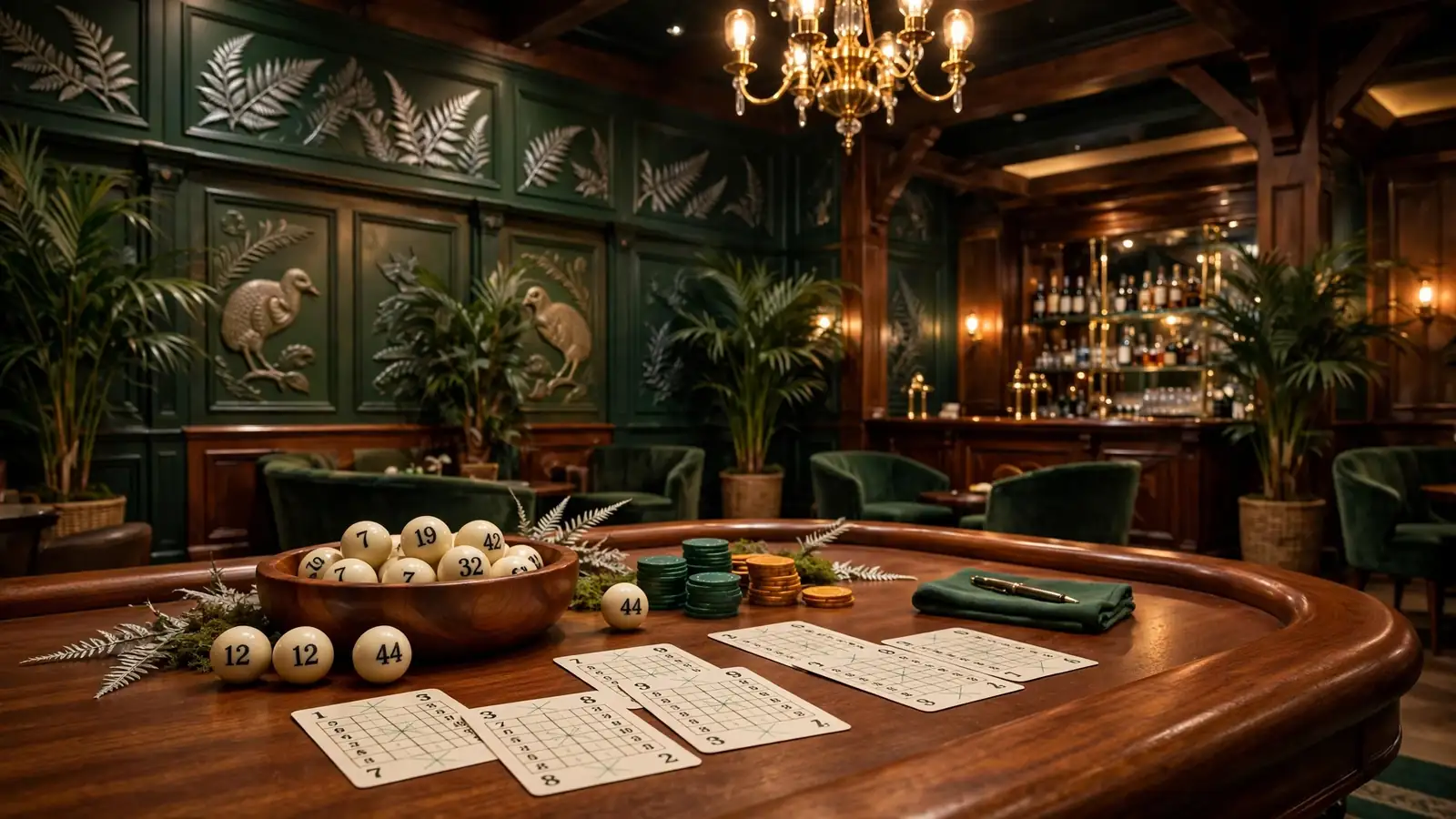
The prize stages progress from one completed line to two, then three and four, before five completed lines qualify as a full house. Each stage is counted on its own ticket. A line completed on one card cannot be added to a line on another to reach the next stage. A set of several partly completed cards therefore does not amount to one ticket with several lines.
That same-ticket rule gives the round a practical boundary. If a ticket completes one line, it has reached the first line stage. To qualify for a later stage, further required lines must also be completed on that ticket. A player holding multiple tickets has separate progress on each; the cards do not pool their marked squares. This is the key point when working out how to play casino bingo in the five-line format: track the result ticket by ticket, rather than treating all selected cards as one combined board.
Calculating the ticket cost
A ticket price needs to be multiplied by the number of tickets in a round, then by the number of rounds played at that selection. An affiliate review gives a hypothetical price of NZ$0.40 per ticket. At that stated price, three tickets make the round cost NZ$1.20. Keeping the same three-ticket selection for ten rounds produces a total of NZ$12.
The calculation is direct:
- NZ$0.40 per ticket × three tickets = NZ$1.20 per round
- NZ$1.20 per round × ten rounds = NZ$12
These figures describe that hypothetical calculation, not a general ticket price or a promise about what a room charges. The final spend depends on the displayed ticket price, the number of tickets selected and the number of rounds entered. If any of those inputs changes, the total changes with it.
For bingo for money at a casino, the cost is the amount committed to tickets across the selected rounds; the line stages describe when a ticket meets a prize condition. They are separate calculations. A full house requires five lines on the same ticket, while buying more tickets increases the ticket outlay without combining lines across cards. Keeping those two points distinct makes both the round’s progression and its cost easier to read.
The 2026 Licensing Transition and What It Means for Bingo
New Zealand’s Online Casino Gambling Act 2026 establishes the country’s first domestic licensing framework for online casino gambling. It does not make every offshore bingo room a New Zealand-licensed service: the licensing process is being introduced in stages, and the full regime is not expected to be operational until 2027.
Legal Compliance
Providers that have not applied for a licence under the 2026 Act must cease online casino gambling in New Zealand by 1 December 2026.
The published legislative outline provides for a maximum of 15 online casino licences. That is a ceiling, not a statement that 15 licences have been issued or that every applicant will qualify. Bingo products sit within the same online casino licensing umbrella as other casino verticals, so bingo is covered by the framework rather than treated as a separate licence category.
The outline also sets financial duties for successful applicants: a 12% point-of-consumption duty and a 0.66% problem gambling levy. These are operator obligations, not charges added directly to a bingo ticket price. Their cost may form part of an operator’s wider business expenses, but the stated rates alone do not show how a particular room will price games or promotions.
The Department of Internal Affairs describes the rollout as staged and expects the licensing regime to become fully operational in 2027. The Act came into force on 1 May 2026, with a transitional window running until 1 December 2026. During that window, online casinos already serving New Zealand before the Act took effect may continue under the transitional provisions. Providers that have not applied for a licence must cease online casino gambling in New Zealand by the end of the window.
This creates a distinction between transitional access and the future licensed market. A room accessible during the transition should not be described as holding a New Zealand licence unless one has actually been granted. Nor does the licence cap identify which providers will ultimately be approved. For bingo, the practical regulatory change is that operators will move from the transitional rules into a domestic licensing system, with application, tax and harm-prevention duties attached to approval.

Deposits and Banking for Bingo Casino Sites
POLi’s role in New Zealand casino deposits ended in 2024, according to a specialist review of payment options. The bank-direct service had been a familiar route for more than a decade, so its discontinuation changed the set of methods described for deposits at bingo casino sites. Payment arrangements now include other bank-transfer routes, debit cards and e-wallets.
A specialist review of New Zealand casino banking identifies Worldline and Blink among the available payment services. It also lists direct transfers from ASB, ANZ, BNZ and Westpac. These are distinct routes: a named payment service is not the same thing as a transfer initiated through a bank account. The bank-transfer options are associated with four New Zealand banks, while Worldline and Blink are presented as separate services.
Debit-card deposits are another listed option. The cards named are Visa and Mastercard debit cards. E-wallets round out the reported alternatives, with Skrill, Neteller and MuchBetter cited as examples. The review describes these as methods used by New Zealand players; availability at an individual bingo room depends on the payment options that room presents.
The practical comparison is therefore between payment channels rather than a single replacement for POLi. Bank transfers connect directly to a listed bank, cards use a debit-card network, and e-wallets use a separate account-based service. A payment brand appearing in a general list does not mean that every bingo casino site accepts it. The relevant option is the one displayed for the particular account and transaction.
Available Banking Alternatives
Following the discontinuation of POLi in 2024, options include payment services like Worldline and Blink, direct transfers from ASB, ANZ, BNZ and Westpac, Visa and Mastercard debit cards, and e-wallets such as Skrill, Neteller and MuchBetter.
For a deposit decision, the payment method and the destination room need to match. A familiar bank or wallet name is not, by itself, confirmation that the method is offered at a specific site. The reported shift is clear: POLi was discontinued, while Worldline, Blink, direct bank transfers, Visa and Mastercard debit, and several e-wallets are identified as alternatives in New Zealand casino banking.
Bingo Alongside Other Casino Games
“Bingo plus casino” describes a combination of game categories, not a separate regulatory status. In New Zealand’s online casino framework, bingo is treated within the broader casino licensing structure alongside other casino verticals. Its presence does not place it outside that framework or create a distinct licensing umbrella of its own.
That distinction matters because a game’s label and its regulatory classification are not the same thing. A site may present bingo as a separate room or section in its interface, but the display does not determine how the product is treated for licensing purposes. The relevant point is that bingo belongs within the online casino category, rather than being a wholly separate kind of online gambling service.

The shared framework also does not, by itself, establish that a particular provider holds a New Zealand licence, that a particular bingo product is available, or that every casino operator offers bingo. Those are separate questions. A category being covered by a licensing system describes the system’s scope; it is not proof of an individual operator’s authorisation or product range.
For the same reason, the phrase “casino with bingo” should be read as a description of a possible mix of products, not as evidence that bingo has a special exemption or a different regulatory route. Casino games can be presented together while remaining subject to the licensing framework that applies to online casino gambling.
Whether bingo appears beside other casino products on a particular site depends on that provider’s offering and its regulatory position. The shared framework explains where bingo sits as a game category; it does not certify any individual service or guarantee that a specific combination is available.
Casino Bingo in New Zealand: Legal and Safety Conditions
New Zealand’s Department of Internal Affairs (DIA) is the country’s primary gambling regulator. The legal position for players is distinct from the licensing position of a provider: under the Gambling Act 2003, New Zealand residents are not prohibited from playing at offshore-licensed bingo rooms. That does not make an offshore operator New Zealand-licensed or place its services under domestic supervision.
The Online Casino Gambling Act 2026 has since established a domestic licensing framework, with a transition period for providers already operating in New Zealand. During that period, the existence of the framework should not be confused with a licence already having been issued to every offshore room. A room’s own licensing claims and New Zealand legal status are separate matters.
Safety measures are practical controls, not assurances about outcomes. A responsible site should provide loss limits, time-outs and mandatory self-exclusion, allowing access to be restricted or paused. Age and identity checks also form part of the stricter requirements for licensed operators. These measures do not change the chance of a result or make gambling a source of income; they limit exposure or access.
The New Zealand Gambling Helpline is a support service for gambling-related harm. Its contact details should be clearly displayed on the site alongside the responsible-play tools, so that support is identifiable without searching through promotional material. If gambling is affecting wellbeing, finances or relationships, contacting the service is a more direct step than relying on account controls alone.
The distinction is straightforward: residents are not barred by the Gambling Act 2003 from using offshore bingo rooms, but that fact is not evidence of a New Zealand licence. DIA’s role as primary regulator concerns the domestic regulatory framework; it should not be read as endorsement or supervision of every offshore room.
Is online bingo legal for players in New Zealand?
Yes. New Zealand residents aged 18 or over may play at offshore-licensed bingo sites; playing at those sites is not prohibited under the Gambling Act 2003.
Are online casinos licensed in New Zealand in 2026?
A New Zealand licensing framework is being introduced in stages, with full operation expected in 2027. The framework provides for up to 15 online casino licences, but an offshore licence is not a New Zealand licence.
What RTP should I expect from online bingo games?
Published RTP figures for bingo games supplied by Pragmatic Play, Playtech and Microgaming generally range from 85% to 92%. RTP is a theoretical return over game play, not a prediction for an individual ticket or session.
How do I deposit at an NZ bingo site after POLi closed?
POLi was discontinued in 2024. Available alternatives include Worldline, Blink, direct bank transfers from ASB, ANZ, BNZ or Westpac, Visa or Mastercard debit, and e-wallets such as Skrill, Neteller and MuchBetter.
Can I play online bingo for real money in NZ?
Yes. Adults aged 18 or over in New Zealand can play for real money at offshore online bingo sites.
Published by the Casino Slots Tips NZ team.